image map Home Favorites Reading About Contact
Showing posts with label Grace. Show all posts

That’s grace...amazing...Jesus

amazing-grace

say something or keep quiet

i wrestle inside
pain emerges
memories surface

what’s the right thing
   what’s the wrong thing
      what’s the Jesus thing

i pick up a rock
just a pebble of pride from my nearby pile
a gentle toss won’t do much damage

perhaps

i throw
it hits
she goes down

but when i throw at her
   i hit Another
      He catches my crossfire

Jesus nabs what i hurl
and buries it dead
i meet no retaliation

that’s grace . . . that’s amazing . . . that’s Jesus

i break inside
awe seeps in
hope seeds

yet the next rock looks up
   throw me; you’ll feel better
      i listen

i retrieve a stone
of self-righteousness
it’s a dis-grace

i raise my arm
but i'm stopped
the Deliverer stays my hand

grip releases
rock falls
healing alights

that’s grace . . . that’s amazing . . . that’s Jesus

when i do the proud thing
   by grace He forgives
when i do the humble thing
   it’s grace that enables
whether i do right or do wrong 
  grace always saves

Grace
He’s amazing
He’s Jesus

* * *

Go too far with grace? There’s no way. Most people haven’t gone far enough in their understanding of it.

. . . Every subject of the Bible, every focus in our lifestyles, everything we think, do, and say is to be grounded in Jesus Christ.

It’s not about behaving the right way. It’s not about having a perfect understanding of the Bible. It’s not about anything that we do or don’t do.

It’s all about Him.

He is grace, and He is the fountainhead of everything else in life.
- STEVE McVEY, 52 Lies Heard in Church Every Sunday

* * *

RELATED:

“By Grace Alone” – Book review

By-Grace-Alone-by-Sinclair-FergusonAfter all, if we are not amazed by God’s grace, can we really be living in it?

By its very nature, God’s grace astonishes those who taste it and amazes those who receive it.
- SINCLAIR FERGUSON, By Grace Alone

We sing “Amazing Grace.”
But do we really find grace amazing?

You may agree or disagree with what Sinclair Ferguson says,

Being amazed by God’s grace is a sign of spiritual vitality. It is a litmus test of how firm and real is our grasp of the Christian gospel and how close is our walk with Jesus Christ.

But we’d all agree we frequently take God’s grace for granted. We expect him to be gracious because we know it’s who he is.

And expecting it turns into thinking we deserve it which turns it away from amazing grace into “accustomed grace.”

O-How-the-Grace-of-God-Amazes-MeSo Ferguson writes another book on grace—a most excellent one. He organizes By Grace Alone around a hymn, “O How the Grace of God Amazes Me,” written and published in 1946 by Emmanuel T. Sibomana, an African pastor.

Grace is not a “thing.”

It is not a substance that can be measured or a commodity to be distributed. It is “the grace of the Lord Jesus Christ” (2 Cor. 13:14).

In essence, it is Jesus Himself.

Seven stanzas of Sibomana’s hymn make up seven chapters in Ferguson’s book.

1. My Chains Fell Off

O how the grace of God amazes me!
It loosed me from my bond and set me free!
What made it happen so? His own will, this much I know,
Set me, as now I show, at liberty.

When we fail to see our sin, we deceive ourselves. But even when we see it, we may only resolve to do better, only to fail anew, adding more sin on top of the original. Grace comes in the form of good news: freedom from our sin nature.

2. Unconditional Love

Being aware of our sins helps us marvel at unconditional love. This chapter focuses on the story of the prodigal son and his discovery of the need of grace.

No one ever discovers the nature of God’s grace without first discovering the reason he or she needs it.

3. At God’s Expense

The two charges leveled against Jesus were blasphemy (that He had made Himself equal with God) and treason (that He had rejected lawfully constituted authority). Why were those two charges so significant? It was because these are the charges each of us faces before the judgment seat of God.

4. A Great Exchange

The great exchange is our gift. His perfection traded for my sins. It’s quite a bargain for us.

The gospel is an invitation to receive a gift. But many people hear it as a summons to do better.

Paul makes it clear that the gospel is not about something we do. It is about what God has done for us in Jesus Christ.

5. Guaranteed Security

Now all my heart’s desire is to abide
In Him, my Savior dear, in Him to hide.
My shield and buckler He, cov’ring and protecting me;
From Satan’s darts I’ll be safe at His side.

Verse 5 and 6 of Sibomana’s hymn (and thus Ferguson’s book) focuses on our trials of the Christian life. We need protection in dangerous territory. And we get it. Shouldn’t we be amazed? And may that amazement help us keep our joy in the trials.

Satan can attack but never ultimately destroy true Christian faith, because we are preserved by grace. Therefore, he seeks to destroy our enjoyment of the grace of God.

In this, sadly, he frequently succeeds.

6. Delivered from Evil

Satan will work however he can—through the “eye gate” and the “passion gate” to deceive us. But, ultimately,

the most sinister thoughts that Satan insinuates into our minds are not enticements to sin but suspicions about God Himself.

. . . The question of God’s nature is foundational for the Christian life. In a sense, every failure in the Christian life can be traced back to a wrong answer to this question.

How we live the Christian life is always an expression of how we think about God.

Refusing to exchange the truth about God for a lie helps us stay strong. Where can we go to find the truth? Over and over, the place to go is: Jesus.

7. True Freedom

Come now, the whole of me, eyes, ears, and voice.
Join me, creation all, with joyful noise:
Praise Him who broke the chain holding me in sin’s domain
And set me free again! Sing and rejoice!

And here the book and the hymn come full circle.

Why is grace amazing? Because it frees us. Not necessarily from the presence of sin (yet), but from the reign of sin. Sin no longer rules us. And we should find that amazing.

But when you begin to understand that in Christ you died to sin and have now been delivered from the dominion of sin; that you are no longer under its bondage; that you no longer need to be a victim of its subtle paralysis—then you find yourself saying not only “Isn’t this amazing grace?” but “What glorious freedom Jesus Christ has bought for me on the cross.”

. . . Do not misunderstand Paul. He is not saying that we will die to sin only if we believe we have died to sin. He is saying that, if you are a Christian, this is the truth about you.

You have died to sin. Therefore, count on it; live in the light of it.

* * *

Do you have a favorite book or scripture on grace?

The Lord has had me soaking in and focusing on grace for awhile now. But of all I’ve read lately on grace, this one—By Grace Alone—ranks high on my list.

Free mp3 download and sheet music (includes an 8th verse) of “O How the Grace of God Amazes Me” 

My thanks to Reformation Trust
for the review copy of this book

Dear God, I still need the gospel

The gospel is not only the most important message in all of history; it is the only essential message in all of history.
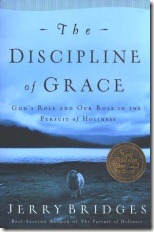
  JERRY BRIDGESthe discipline of grace, The Discipline of Grace

What I know now is the gospel—the good news—wasn’t just for the single twinkle in time when You crossed me over from lost to saved.

The gospel is still good news to me.
Today.
Now.

I learned about discipline before I learned about grace. Discipline is good. You take me places with it.

  • If I’m disciplined in study, You get me through the Bible over and over.
  • If I’m disciplined in prayer, I can praise, confess, petition, and thank You every day.
  • If I’m disciplined in memorization, I can hide chapter after chapter of Your words in my heart for use later.

Good things? Yes. Discipline opens up Your blessings.

But those blessings don’t come from discipline.
They come from grace.

Even discipline itself is a gift of grace.

If I pursue discipline without grace, I’ll fail.

  • I can’t obey perfectly on my own.
  • I can’t obtain righteousness at all on my own.
  • I can’t serve those I love very well on my own.

I need Christ’s obedience, Christ’s righteousness, and Christ’s love.

At the cross, Jesus became grace, and grace is the gospel.
If discipline is good, grace is better. Because Jesus is best.

You saved me years ago; You save me today. I need saving from myself daily. Not just saving from hell when I die, but rescue from being sharp-tongued to my sweet husband, and deliverance from bitterness over hurts I could be coddling, and freedom from thinking I have to perform perfectly to deserve love.

I need grace not just for my past or future, but now. 
There’s never a moment I don’t need it.

And there’s never a moment You don’t give it.
You are the gospel, the best news I’ve ever known.

* * *

When do you need the gospel? 

More on Chapter 3, “Preach the Gospel to Yourself” at Challies.

Thoughts from
Chapter One, “How Good Is Good Enough?”
Chapter Two, “The Pharisee and the Tax Collector”
Next Week, Chapter Four, “We Died to Sin”
All chapter summaries

Am I self-righteous?

Do you ever feel smugly satisfied with your Christian life?

You show up at church each Sunday, read your Bible daily, read clean Christian books like Jerry Bridges’ The Discipline of Grace . . .the discipline of grace

And so on, until, like the Pharisee who thought he was better than the tax collector (Luke 18:11-12), we, too, through self-righteousness, can “become the classic example of religious pride and self-satisfaction.” That’s how Bridges puts it in Chapter Two.

How do we keep that from happening?

Partially by not confining sin to only the biggies: adultery, murder, stealing . . . and instead recognizing our own “refined” sins, the ones that nice pew-sitters like us commit.

They’re just as obnoxious to God.

Bridges says many of these sins are in areas of interpersonal relationships. (Feeling uncomfortable yet?) Things like:

  • resentment
  • bitterness
  • an unforgiving spirit
  • impatience
  • irritability

As much as we don’t want to admit it, these transgressions are also rebellion against authority.

The seriousness of sin is not simply measured by its consequences, but by the authority of the One who gives the command.

Dare we look inward to see if we’re guilty of the “hideousness of the sin of self-righteousness”?

The problem with self righteousness is that it seems almost impossible to recognize in ourselves.

We will own up to almost any other sin, but not the sin of self-righteousness.

When we have this attitude, though, we deprive ourselves of the joy of living in the grace of  God. Because, you see, grace is only for sinners.

And while we are new creations in Christ—saints standing guilt-free before God because of Christ’s blood—we do still sin.

We still need grace.

Bridges quotes a Puritan preacher: “Even our tears of repentance need to be washed in the blood of the Lamb.”

So ends Chapter Two with this:

So our best works can never earn us one bit of favor with God.

Let us then turn our attention from our own performance, whether it seems good or bad to us, and look to the gospel of Jesus Christ, which is God’s provision for our sin, not only on the day we trusted Christ for our salvation but every day of our Christian lives.

* * *

Do you struggle with self-righteousness, too?

Summary of Chapter Two at Challies, “The Pharisee and the Tax Collector”

[NEXT WEEK: Chapter Three, “Preach the Gospel to Yourself”]

Chapter One, “How Good Is Good Enough?”
All chapter summaries

Grace in El Salvador - video

Thanks to all who prayed this spring and summer for my trip to El Salvador in July.

I count you as partners in grace, together following Jesus to do good things he already planned for us to do.

For we are his workmanship, created in Christ Jesus for good works, which God prepared beforehand, that we should walk in them.
Ephesians 2:10

Thanks to my gifted daughter Jenna for partnering with us in taking almost all these photos. Her view of the trip is here.

* * *

Please let me know how I can return the favor and pray for you.

Grace-in-El-Salvador-2012

2012: My year to. . .

My-Year-to-Venture

How good is good enough?

When we pray to God for His blessing, He does not examine our performance to see if we are worthy.

Rather, He looks to see if we are trusting in the merit of His Son as our only hope for securing His blessing.
  - JERRY BRIDGES

the discipline of graceMaybe it’s our culture.
Maybe it’s just human nature.

Whichever, it’s hard to remember not only were we saved by grace, but we continue to live only by grace every single day.

What happens to believers when we forget?

1. We become proud
We think God is pleased with us when we are pleased with us.

I feel good about myself when I give the saleslady at the door a glass of water, when I give up “my” time to sit with a friend, when I turn off my laptop early to give full attention to my husband. Isn’t God giddy to rain blessings on me now?

2. We feel guilty
But when I say no to the class on Israel, or I don’t check on my house-bound neighbor, or I’m not as friendly as I could have been to the lady beside me on the pew, I feel guilty. Surely God won’t want to bless me now.

Both perspectives are wrong. Because both are contingent upon me, not God.

Granted, our intentions/actions can either be God-honoring or God-dishonoring, but we don’t forfeit God’s mercy and blessing beyond natural consequence because of what we do or don’t do.

That wouldn’t be grace.

And grace means I no longer get what I deserve, based on my performance, but I get better.

Because Jesus is better than me. Not only at the moment of my salvation, but every second since. 

* * *

Thoughts from Chapter One, “How Good Is Good Enough?”
in The Discipline of Grace by Jerry Bridges

More comments at Challies

My chapter summaries

“The Truth about Grace” – Book review

We are all like the boy who had no ability.

God graciously puts us on the team, not because of our own ability, but purely by His sovereign grace. And He gives us the ability to play the game.

So get in the game and give thanks for the holy privilege of serving Jesus Christ.
~ JOHN MACARTHUR

Truth-about-GraceWhat is grace?

John MacArthur explains the ins and outs of it in The Truth about Grace. His proper definition:

Grace is “the free and benevolent influence of a holy God operating sovereignly in the lives of undeserving sinners.”

What is grace not?

  • It’s not “some kind of ethereal blessing that lies idle until we appropriate it.” God initiates it, not us (Ephesians 1:5-6).
  • It’s not a one-time event and then it’s over. We stand in it (Romans 5:2).
  • It’s not something we control. We are stewards of it, but it’s not subject to us (1 Peter 4:10).

MacArthur explains two kinds of grace: common grace and special grace. Common grace is God’s goodness to all mankind. Special grace, also referred to as saving grace, is “the irresistible work of God that frees men and women from the penalty and power of sin, renewing the inner person and sanctifying the sinner through the operation of the Holy Spirit.” This is the grace referred to throughout this book.

Who receives this special grace? Believers. “Every believer receives the grace of God as a result of responding to the good news. And the good news is that salvation is by grace.”

Until this salvation brings us to life, we remain spiritually dead in our total depravity, unable to please God with even our good—and religious—deeds.

I agree, although I don’t agree with all of MacArthur’s interpretations in this book. Sometimes he comes across harsh (he admits it too):

One well-known evangelical friend thought he was complimenting me when he introduced me by saying, “This is John MacArthur, who is much nicer in person than he is in his books.”

I smiled and said, “In person it’s much easier to demonstrate the love of Christ.”

But I appreciate his fidelity to scripture and his consistent message that grace saves.

The choice we all make is this: either we’re good enough on our own, through our belief system and morality, to make it to heaven; or we’re not, and we have to cast ourselves on the mercy of God through Christ to get there.

Those are the only two systems of religion in the world. One is a religion of human merit; the other recognizes that we find true merit in Christ alone, and it comes to the sinner only by grace.

He also makes me think:

I’ve heard preachers say the narrow way is the way of Christianity that people choose when they want to go to heaven, and the broad way is the way people choose who are content to go to hell.

But they are misinformed or confused.

It is not a contrast between godliness and Christianity on one hand and irreligious, lewd, lascivious pagan masses headed merrily for hell on the other. It is a contrast between two kinds of religions, both roads marked “This Way to Heaven.”

Satan doesn’t put up a sign that says, “Hell— Exit Here.” That’s not his style. People on the broad road think that road goes to heaven.

And he always comes back around to glorifying God in all things.

God’s ultimate purpose in our salvation is to exalt His sovereign grace in order “that in the ages to come He might show the surpassing riches of His grace in kindness toward us in Christ Jesus” (v. 7 NASB).

So our loving Father glorifies Himself even as He blesses us. His grace is the centerpiece of His glory.

From the first moment of salvation throughout “the ages to come,” we never stop benefiting from His grace and goodness to us. At no point does grace stop and human effort take over.

Is this a book worth reading about grace? Yes, it is.

True grace is more than just a giant freebie, opening the door to heaven in the sweet by and by, but leaving us to wallow in sin in the bitter here and now.

Grace is God presently at work in our lives.

* * *

What book on grace would you recommend?

My thanks to Thomas Nelson
for the review copy of this book.

You’re not good enough

not-good-enough-ant-work-hardGrace stealers

It’s good to be good. I get that. God calls us to do good things so he can be glorified (Matthew 5:16).

But do we carry it too far?

Not in doing good things (let’s always want that!), but by incorrectly thinking that doing good things makes us good.

Immediately after Paul told the Philippians to fill up on joy (Philippians 3:1), he gave them a very stern warning:

“Look out for the dogs!
Look out for the evildoers!
Look out for those who mutilate the flesh!”
(Philippians 3:2)

Who were those dogs? They were joy thieves. Grace stealers. They were Jews who were trying to pull the fresh Christians away from grace. And back into law.

The voices say...

They were the voices we still hear today, whispering, and sometimes shouting:

But Paul gave them a confident and reassuring answer that we need to listen to.

He said we don’t have to be good enough.

And he should know. If anybody had a beefy spiritual resume, it was Paul (Philippians 3:4). He had credentials. His Benjamite blood line was pure, traceable all the way back to Jacob, as far as a Jew could go.

He was a Pharisee on fire for obeying the law, far more zealous than any Sadducee. But...

Was it enough? Could his credentials earn his salvation?

Pumping the pride

Can yours? What do you take pride in?

  • Maybe you have a stellar record of church attendance
  • Or you teach a Bible class or two
  • Or you make great sacrifices to homeschool your kids

Ah, great items for the resume, yes?
No.

While those may be good things, they’re still zemia compared to knowing Christ. Zemia is the Greek word Paul used for “loss” in Philippians 3:8. As in detriment. Disadvantage.

If we rely on our own credentials to build our joy, we’re at a disadvantage. We waste energy trying to be perfect on our own.

Instead, concentrate on better knowing the one who already is perfect, who is enough. Hang out with him. Let his blood rub off on us.

His perfection is enough for all of us. 

It’s who you know

When we try to be right by our own goodness, we’re wrong.

But when we accept the righteousness from God that depends on faith (Philippians 3:9), we go all the way through suffering to the other side of resurrection.

It’s painful to try to be perfect on our own.
And it’s unnecessary. Christ has already done it for us.

So let’s heed Paul’s warnings and do as he did:

  1. Rejoice in the Lord
  2. Beware of grace stealers
  3. Put no confidence in our own works
  4. Know Christ and build faith in him

Because it’s not what we do for him, it’s that we know him.
And even though we will never be good enough, he is. For us.

And that is more than enough.

*  * *

Do you struggle trying to be perfect? Is it hard to accept that you will never be good enough?

originally posted at Do Not Depart
revised here for the archives

“Searching for God Knows What”

It makes you wonder if guys like John the Evangelist and Paul and Moses wouldn’t look at our systematic theology charts, our lists and mathematical formulas, and scratch their heads to say, Well, it’s technically true; it just isn’t meaningful.

...I think ideas have to sink very deeply into a person’s soul, into their being, before they can effect change, and lists rarely sink deeply into a person’s soul.
     - DONALD MILLER

If you like your religion outside the box, you’d probably like Donald Miller’s books. Blue like Jazz. A Million Miles in a Thousand Years.

And this one, Searching for God Knows What. It’s been out for 8 years (reprinted and revised in 2010), but I just read it this year (thanks for the loan, sis).

Searching-for-God-Knows-What

Miller believes God wants a relationship with us, not have us follow a list of rules or live by a formula. He asks hard questions and doesn’t give easy answers in this book, but he gives real ones, through his stories and his own wonderings and wanderings.

Here are some highlights:

* ...what if we stopped looking at the rules and lists and formulas and rather looked through them at the larger and more obvious message? What if the motive behind our theology was relational?

* Becoming a Christian might look more like falling in love than baking cookies.

* Few places in Scripture speak to the Christian conversion experience through any method other than relational metaphor.

* There is moral law, to be sure, but moral law is not our path to heaven; our duty involves knowing and being known by Christ.

* The hijacking of the concept of morality began, of course, when we reduced Scripture to formula and a love story to theology, and finally morality to rules.
   It is a very different thing to break a rule than it is to cheat on a lover. A person’s mind can do all sorts of things his heart would never let him do.
  
If we think of God’s grace as a technicality, a theological precept, we can disobey without the slightest feeling of guilt, but if we think of God’s grace as a relational invitation, an outreach of love, we are pretty much jerks for belittling the gesture.

* * *

How to build an altar of grace, or Don’t waste your rocks

Things you use

  • A bag of rocks
    Easy to find. Limitless supply prepackaged with your fleshly nature. 
    Any size is acceptable.bag-of-rocks
    Available in a variety of shapes: anger, selfishness, greediness, sarcasm, discontentment, pride, anxiety, lust, ungratefulness, laziness, etc.
  • A target
    Unfortunately, commonly found in any situation.
    Easily available: a spouse, a child, a parent, a friend, a neighbor, even a stranger will do in a pinch, as long as within throwing distance. 
    Don’t forget you also make an easy mark for your own rocks.
  • A Savior   [CRITICAL!]
    For full effect, no generics allowed; name-brand only. Must be Jesus. Substitutes will not be accepted.

Procedures

Option 1: Drop the rock

  1. With target in view, pick up a rock. Proceed to aim for heart or head of your target for maximum impact.
  2. Seek God for guidance.
  3. Follow his advice by releasing the rock. As it drops, landing by your feet, take note: This is the location of your altar of grace.
  4. Fall on your knees at the altar and thank God for giving you grace to drop the rock.
  5. Repeat daily, as often as needed, eventually beginning with step 2 and avoiding step 1 altogether.

Option 2: Throw the rock
[WARNING: This option requires additional steps, extended time, and consequential damage]

  1. With target in view, pick up a rock. Proceed to aim for heart or head of your target for maximum impact.
  2. Seek God for advice. [NOTE: This step is often skipped with Option 2]
  3. If followed step 2, advice still ignored. Proceed to step 4.
    If skipped step 2, proceed immediately to step 4.
  4. Attempt to relieve your pain, frustrations, jealousy, etc., by throwing your rock at intended target. If intended target is unavailable, any nearby person or object will suffice.
  5. Follow path of rock upon its release. Note any peripheral or full damage to target.  Prepare for collateral damage by becoming defensive, stonewalling, running, or taking further offensive measures.
  6. Be surprised when rock’s ultimate target is the Savior. Watch as he catches rock, and throws it back on the pile building by your feet, adding another rock to your altar of grace.
  7. Fall on your knees in repentance for throwing the rock, and thank God for his grace to forgive you.
  8. Repeat step 1 and steps 3-6 as few times as possible, eventually giving up Option 2 altogether. 

altar of graceResults

  • Size
    Your altar of grace will grow larger and larger with each dropped rock and each thrown rock. Use all rocks as evidence of God’s grace to keep you from sinning in the first place and to forgive you when you do sin.
  • Intensity
    Kneel frequently by your altar to praise the Father for grace given you to give to others and for giving you the grace of forgiveness as often as needed. May he receive all the glory!

Additional information available

* * *

If I do it for you...

do-for-one    If I do it for you, I’ll have to do it for everybody.
     I can’t do it for everybody.
     So the answer is, “No” to you.

I’ve heard that argument all my life. It’s logical, right? I’ve given that argument, too. Even today.
     Daughter: Take lasagna tonight to the potluck. 
     Me: I can’t. I don’t have enough for everybody.

So instead, nobody will get any.

I’m beginning to question my logic.

I’m blaming Andy Stanley. Yesterday I listened to his podcast. He told me,

  • Let go of the fallacy of “If you can’t do for everybody, do for no one.”
  • Instead, “Do for one what you wish you could do for everyone.”

He said quit trying to be fair. Life isn’t fair.

I’ll add, grace isn’t fair either.
Aren’t we glad?

Even though Jesus died for everyone, he knew not all would believe in him. What if he had reasoned, “But if everybody won’t believe, I shouldn’t die for anybody.” There would go our salvation.

Or “If I change the laws of nature this time, she’ll expect it every time.” We’d have had no miracles.

If grace were fair, there’d be no grace. 

Instead of being fair, can we just be loving?
Just because we can’t do it every time, can’t we at least do it this time?
Can we do what we can for whom we can, even when we can’t do it for everyone?

  • Water the next-door-neighbor’s flowers, even though we can’t water the whole neighborhood.
  • Send the sympathy card to the widow we know, even though the obituary page is overflowing.
  • Buy the thin mint cookies from the Girl Scout who asks, even though we can’t buy them from the whole troop.

You don’t have to do it all to still do something.
Do what you can.
Your one act of grace won’t be fair.

But somebody will be happy to receive it.

* * *

Have you been the recipient of an “unfair” gift? Were you glad?

It’s not goodness I need

I finally wrote God a letter.

I do that when I get so stuck on an issue that I can’t pray uncluttered.

Father,
What’s really going on with [insert troubling issue here]?

It started because of one thing. It seemed so wrong I could do nothing less than walk away from it.

So I was going to wait it out. But the longer it takes, the more I see that one thing is just a symptom of a much larger thing: is the gospel about works or grace?

If salvation is by works, then it’s manifested through fear of ever changing anything for fear of offending you, of getting it wrong, of breaking a rule.

If salvation is by grace, then it’s safe to take risks for you and trust your Spirit to get it right in me, even if it means failing first and starting over.

  • Works = trust in my allegiance to the rules
  • Grace = trust in Jesus
I’m not changed by following a book.
I am transformed by following Jesus.
  • Works = become an expert in the details to feel safe and in control
  • Grace = totally depend on Jesus even if it feels out of my control

Am I thinking clearly, God?

[etc.]

I didn’t mail the letter.

But I’m pretty sure God received it anyway.
Because he keeps answering me back.

He’s letting me know that being good is nice, but good is not best.
Good is not grace.
More important than me being good is God being glorified.

Obedience isn’t the goal.
Loving him is the goal.
Obedience is just one of the ways I love him. 

It’s not goodness I need, it’s God.  

Can I get stuck on that, Father?
That’s good news.
That’s your gospel.

I love you,
Lisa


* * *

Do you ever resort to writing a letter to God, too?

The difference is Grace

i'll-take-grace

C. S. Lewis walked into a room where some of his friends had been having a discussion for several hours. He asked what they were talking about.

They said, “We have been discussing what makes Christianity different than all other religions.”

C. S. Lewis said, “That’s easy. It’s grace.” And he walked out of the room.

He was right.

A single word captures the difference between Christianity and all other religions.

Grace.
     ~ Joe Coffey, Bob Bevington, Red Like Blood

I’ve seen Grace.
I’ve felt Grace.
I’ve been touched by Grace.

Now, nothing else will do.
It’s Christ or nothing.
I’ll take Grace.

He’s everything.

As for you, O LORD, you will not restrain your mercy from me;
your steadfast love and your faithfulness will ever preserve me!
Psalm 40:11

* * *

RELATED:

Arrogance strikes again

God opposes the proudWe are eating our biscuits at Hardee’s, chatting as sisters, aunts, in-laws.

When wham—it hits us out of nowhere.
Arrogance.

Looking out the window, we see the man. And we laugh.
Oh, part of us tries not to.
But not hard enough.

That hurts.
When will pride die?
I’m just another sinner in need of everyday grace.

The man doesn’t see us on the other side of the glass. He is cleaning out a taxi cab. His brown toupee falls several inches short of his aging gray hair sticking out boldly underneath. His clothes are ragged. His appearance screams homeless.

We try not to stare, but this is the cab driver? Really? Is he competent to get someone from point A to point B? Does the cab company have no regulations on whom they hire? We make a mental note never to call this one.

Oh, how my God delights in my need of Him.
I crave His forgiveness.
He gives it.

My middle-class American haughtiness is ugly. Sin always is.

Granted, this man looks far from professional, but who’s to say he’s not the most capable, friendliest cab driver in town? And even if he’s not, he doesn’t deserve a group of women snickering behind his back because he wears a bad toupee.

He’s made in the image of God just like I am.
He wants peace and joy and happiness just like I do.
He was died for on the cross just like I was.

Oh, Lord. When will I grow humble?
When will I see and pray, instead of see and snicker?
When will your grace for me run dry?

Never.
Never?
Never.

Not at home.
Not in suburbia.
Not at Hardee’s.

His grace exceeds my sin.
I never know when His grace is going to hit me.
But may I catch it every time. And be changed by it.

~   +   ~   +   ~   +   ~   +   ~   +   ~   +   ~   +   ~

Continuing my grace count to 1,000:

# 452—469
~ Grape jelly. Saturday mornings. Family that are friends.

~ Compassionate veterinarian. Our dog still alive. My husband back home.

~ Eye doctors. Eye drops. Good insurance.

~ Open mic night at church. Open hearts. Open prayers.

~ Cleared-up conversations. Plans a-go. God who answers.

~ Another chance.
~ Grace that never ends.
~ God who always forgives.

* * *

When grace doesn’t seem like enough

“The fact of suffering undoubtedly constitutes the single greatest challenge to the Christian faith, and has been in every generation.”
~ JOHN STOTT, The Cross of Christ

I met Glorhy in El Salvador this summer, a gift, a radiant teenager who spoke a little English. We connected. I can’t explain exactly why or how.

We became friends. Even on Facebook. (I asked her, “Cómo se dice “facebook” en español? How do you say “facebook” in Spanish? Her reply, “Facebook.” Go figure.)

glorhyBut there’s more I can’t explain.

Glorhy is sick. It’s cancer. And because superior healthcare isn’t exactly convenient or cheap for her in El Salvador, Glorhy isn’t getting better.

I cry out to God, “Help her, Father. Please?”

I tell Glorhy that it will be okay. I send messages that say things like, “God is strong” and “God will give you courage.”

But I feel like the man sending away the needy with “Go in peace, be warm and filled” (James 2:15-16).

Because I want to promise, “God will heal your body.”
But I can’t say that. At least not in this realm.

To console me in my helplessness, I remind myself of what I know.
• I know our afflictions here are light and momentary compared to eternity (2 Corinthians 4:17).
• I know the needy we will always have with us (Matthew 26:11).  
• I know Jesus didn’t heal everybody in the flesh even when he was here.

But he did heal this one (Luke 4:39) and that one (Matthew 8:3) and this one (Mark 2:11-12).

So why not this one, Lord?
I can’t explain it.

If there’s one thing that gets us, believers and non-believers alike, it’s unexplained suffering.

Who hasn’t asked, “Why do bad things happen to good people?”

I don’t doubt that God is powerful enough to prevent bad things from happening.
I don’t doubt that God is loving enough to want the best for us.

But what I can’t know is how God will choose to use his power to do ultimate good.

And while I also know his grace is enough for me,
what about Glorhy?

Is it enough for her?
She lacks financial resources I have; she lacks spiritual support I have; she lacks a million other things I have.

Her needs appear to outstrip her supplies.

But she doesn’t lack grace.
She doesn’t lack grace.
I must remember.

And I must pray.
• I pray for a healthy soul enclosed in a sick body.
• I pray for the Spirit to engulf her spirit.
• I pray lavish grace floods out her fears.

If his grace is enough for me—for you—I must trust:
it’s enough for her too.

* * *

Glorhy has asked me to ask the church to pray for her.

Will you word a request to the Father today on Glorhy’s behalf?
Thank you, church.
Thank you, Lord.


This ends my reading of The Cross of Christ with Challies.
All chapter summaries

Why not? Abandon yourself to grace

In the Christian life all is of grace from the very beginning to the very end.

That is the message, that is the doctrine, that is the principle.
~ MARTYN LLOYD-JONES, Spiritual Depression

“Why not?”

Is that what joy is?
Abandon?
The “why not?” moments?

  • Letting go of false restraints that tie you earthbound
  • Throwing yourself into the true Known of the unknown
  • Saying “yes!” to His offers of grace.

That’s how I broke my arm.

It was the weekend of the worst ice storm in memory to hit north Alabama, February 1996.

1996Jeff had already been playing outside with our girls.
But not me.
I was warm and happy inside, only venturing out as official Icicle Photographer.

Until I decided...
“Why not? Why not pull the sled with Morgan? Wouldn’t that be fun?”

But upon barely clearing our front door, I slipped on ice.

And fell. Badly.

My left arm and wrist bones no longer aligned.
I felt no joy in abandon.
My “why not?” turned into “what was I thinking?”

Slowly, carefully, by the grace of God, Jeff drove over sheets of ice to the hospital a county away. I tried to be brave but I was scared.

Would I ever be able to use my left hand again?

My first broken bones, age 33.cast-on-arm

But joy showed up.

When offers of grace came in recovery, I said, “Why not?”

  • It was in friends folding my towels.
  • It was in a husband washing my hair.
  • It was in my mom and mother-in-law making meals.

Joy was where it had always been—not in activities,
but in grace.

The Creator—who made ice and bones and doctors—unwrapped grace in gifts I wouldn’t have opened otherwise.

Abandoning myself to “Why not?” still doesn’t come naturally.
But joy is found there—in the abandon to Grace.

~  +  ~  +  ~  +  ~  +  ~

More graces to count...

# 388—396

...bones that healed...stories with happy endings
...memories of grace...grace to remember
...new used book in the mailbox...free samples sent to Kindle
...10 pages a day in Bonhoeffer...20 pages a day in Unbroken
...not living during World War 2

* * *

Freedom and grace

Now the Lord is the Spirit,
and where the Spirit of the Lord is,
there is freedom.

2 Corinthians 3:17

free_delivery

Grace is one of the first things to go.

I realized that about myself yesterday. I’m not proud of it. When I’m feeling stressed, my ability to tolerate even minor annoyances decreases drastically.

I found myself talking back to the radio as I was getting ready for church (yes, church!): “How about playing some MUSIC instead of all that chit-chat???”

I knew I was in need of much grace. And was delivering little.

So when Romans 1:31 was read aloud in our morning church service—a list of things that should not be done—one phrase spit at me:
without mercy.

Without mercy.

Was that me?

I moved on to James 2:13: “For judgment will be without mercy to anyone who has shown no mercy; mercy triumphs over judgment.”

Uh-oh.

I looked up the Greek word for mercy, Strong’s 1656, eleos. And immeditely noticed the word that followed it, Strong’s 1657, was eleutheria, meaning freedom.

Mercy. Freedom.
Side by side.

Was there a stronger connection between the two words other than Greek alphabetical order?

Yes.
While judgment is bound up in law, mercy is released in freedom.
Freedom allows opportunity.
And through those opportunities we love.

For you were called to freedom, brothers. Only do not use your freedom as an opportunity for the flesh, but through love serve one another. 
For the whole law is fulfilled in one word: “You shall love your neighbor as yourself.”
Galatians 5:13-14

Live as people who are free, not using your freedom as a cover-up for evil, but living as servants of God.
Honor everyone. Love the brotherhood. Fear God.
1 Peter 2:16-17a

When I’m bound, tied up by my own anxieties and worries, I’m not free to deliver grace to others.
I’m not free to show grace.
I’m simply, well, not free.

But when I embrace my freedom—because of mercy that has been freely delivered to me through the Spirit of the Lord—I can give grace again.

That is freedom.

And in freedom, grace is never the first thing to go; it never leaves at all.

~ ~ ~ ~ ~

I continue counting God’s gifts to 1000,
today in freedom, through grace:

- Freedom to be a stay-at-home mom (# 281)
- Freedom to travel about the country at will (# 282)
- Freedom to vote for my leaders (# 283)
- Freedom to speak out when I disagree with them (# 284)
- Freedom to serve and love others (# 285)
- Freedom to openly worship Jesus as Lord (# 286)
- Freedom to fall and get up again (# 287)
- Freedom from sin’s curse on me (# 288)

* * *

What freedoms are you thankful for today?

RELATED:

When you see the signs, look for grace

empty_grocery_cartAt first glance, I thought she was Mrs. H.

But I knew Mrs. H had died and would certainly not be in a grocery store anyway. She had Alzheimer’s in her later years and was already in an assisted living facility when I met her.

The second impression was her question to me (or anyone standing nearby), “Where do they keep the bread nowadays? I can’t find it anywhere!”

I pointed and said, “Aisle 11, the far side of the store.”

But something went off inside me. I glanced in her cart, empty except for one head of lettuce. Her eyes seemed empty too.

The third sign: ten minutes later, I saw her still wandering the store, still with an empty cart except for the lettuce. I knew. The signs added up. Something was wrong in her world. Lord, send mercy.

     Earlier that morning, I had a funny feeling when I woke up.
A rumbling in my heart, my attitude uncomfortable with my own thoughts.
An unclean conscience?
I wrote it off.

Sign two? I read words that weren’t meant for me. Surely.
So why were they clinging?

The third sign was a scripture.
It was pointing a finger. At me. No escape. The signs were clear.
My soul was hungry.

When God sends you one sign, you might not notice.
Two, okay, you begin to wonder.
But three? He’s demanding your attention.

     You start looking around for Grace. 

I did. I found it in a course-change. And took it. Not cheerily, not cleanly.

But when Grace finds you, be grateful for its detour. 

And later when the worship music came, my heart could sing.

     When you feel the hunger, eat the Bread.

When you see the signs that something is wrong in your world,
fill up on Grace.

I feed on worship. Heavy praise.
It averts my eyes to Him.
He can handle my empty, guilty gaze.
And make me full again.

I need Grace when I’m adrift.
Strength for the right turn.
Wisdom to bypass my stupor.

I don’t know if my grocery store friend ever found her bread.
I pray she did.

I thank God I did.

They said to him, “Sir, give us this bread always.”

Jesus said to them, “I am the bread of life;
whoever comes to me shall not hunger...”
John 6:34-35

* * *

Do you see the signs? Are you looking for Grace too?

I know where to find the Bread.

There’s always another layer

colored pencilsShe (who prefers anonymity for this story) pulled out her tin of colored pencils to write in her prayer journal.

Then she suddenly drew in a deep breath – what???

There’s another layer!
Beneath one layer of pencils was another layer of more pencils.
How long had they been there? Unused? Unnoticed?

And now delighted in.

There’s always another layer.

I put clean sheets on the bed Friday morning before I left. My in-laws were coming for the night and I wanted them to have fresh ones.

Meanwhile, my daughter was putting clean sheets on her bed because I was coming for the night and she wanted me to have fresh ones.

There’s always another layer.

Peel back one fold and find another. It’s the cycle of grace. God planned it so.

  • It’s my baby girl helping me pick out a dress. For her wedding.
  • It’s remembering teaching her cursive, and now watching her write in it to address college graduation invitations.
  • It’s watching her take charge at her job in the greenhouses. And remembering when she planted her first little flower bed at our old house.

Layers.
Depth.
Thickness.

It’s the God-way. His bottomless pit of surprises.

He always has another layer of grace.

Oh, the depth of the riches and wisdom and knowledge of God! How unsearchable are his judgments and how inscrutable his ways!
Romans 11:33


Adding more layers of praise for his grace surprises...

# 105....110
~ fresh chocolate chip cookies made special for me
~ buying dresses together
~ sharing a slice of caramel pie
~ Icees
~ meeting with the caterer
~ graduation invitations

# 111....115
~ a date with my Kindle at Milo’s
~ finishing one book so I can start another
~ last week of school but never of learning
~ making it to 2 showers for 2 friends in 2 cities in 1 afternoon 
~ orange slices that remind me of Grandma’s house
orange slices# 116....118
~ a husband who wants to kiss me often
~ a daughter having such fun she forgets what time it is
~ but apologizes very responsibly for it

# 119
~ a God who never never never never runs out of grace

* * *

How has God’s unending grace surprised you lately?

Yet another voice on #bellbrouhaha

Rob_Bell_It begins when
     Man A says, “The scripture means this.”

Responses follow,
     Man B says, “You’re wrong; study more.”
     Man C says, “You’re right; I agree.”
     Man D says, “I need to study more.”
     Man E says, “You’re a heretic and a liar!”

The screaming of Man E
echoes 
the loudest
on the latest #brouhaha.

Whether right or wrong on interpretation,
may voices question
motives
cautiously
only as proof is unveiled.

Christians condemning Christians
does
not
make God look good.

Grace in the discussion
is a more godly approach
to advance the Kingdom.

I wish we could
live it
that simply.

May it begin
with me.
     What will I say?

Let your speech always be gracious,
seasoned with salt,
so that you may know
how you ought to answer each person.
Colossians 4:6

* * *

When you disagree on scripture interpretations,
how do you still hold to truth
without maligning others’ character?

LinkWithin

Related Posts with Thumbnails