image map Home Favorites Reading About Contact
Showing posts with label Discipline of Grace. Show all posts

In the pain, is God still good?

pain-forehead

Adversity is not a discipline we undertake ourselves, but is imposed on us by God as a means of spiritual growth.

As Hebrews 12:10 says, “God disciplines us for our good, that we may share in his holiness.” The purpose of the discipline of adversity, then, is to make us more holy.
- JERRY BRIDGES, The Discipline of Grace

Is God good?

I don’t want to complain. But sometimes I complain anyway. I can’t help it.

I cave in to the temptation to think God isn’t as good as he could be.

Because if God is so good, why doesn’t he lift the veil of depression off my friend who cries out to him for help? Why doesn’t he give clearer direction to a group of his people who are sincerely trying to please him but don’t know which steps to take next? Why doesn’t he remove the pull of addiction from those who long to be released from it, for his own glory?

For crying out loud, why doesn’t he at least provide minimal food for the starving children in Africa?

And in a more personal matter, why doesn’t he make my back pain go away?

He can. He can do all of the above. Without the tiniest drain on his power. With or without human help.

But he hasn’t.

Purpose in pain

And therein lies the greatest struggle many have with believing in him.

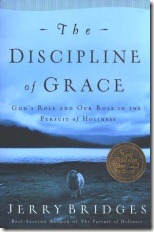
In the last chapter of The Discipline of Grace, Jerry Bridges tackles this topic. How does grace meet adversity?

He starts off by saying the discipline of adversity is itself a sign of grace: “God’s discipline, which comes to us in the form of adversity or hardship, is an indication of His loving care, not a token of His disfavor.”

He’s more bold than I am in claiming God indeed delivers the hardships himself. (I still have questions, even after reading this book three times.) But because he believes God’s hand is in every hardship we encounter, it makes him more accepting that there is purpose.

And maybe that’s the saving factor for me, too. That’s what keeps me from turning away from God in anger. If there is—can be—a REASON for all this (regardless of its source), then I can deal with it and still see God as good.

Because I can take pain much better when I know it has a purpose.

All hardship of whatever kind has a disciplinary purpose for us. There is no such thing as pain without a purpose in the life of a believer.

This does not necessarily mean a particular hardship is related to a specific act or habit of sin in our lives.

It does mean that every expression of discipline has as its intended end conformity to the likeness of Christ.

So the purpose is? To make us more like Christ.

Be like Christ

I want to be like Jesus, accepting that God is loving me by allowing my pain. That I can trust him so much that I don’t complain about it. That he can use my pain as fuel for more faith, not less, in his goodness.

That’s who I want to be. I’m not there yet.

But maybe the grace in pain is what will get me there like nothing else will.

It’s brought me this far already and it’s been worth it for the ways I’ve already seen God and know his love for me.

I don’t choose my adversities (for the most part). What I can choose is how I’ll respond (for the most part; I have to depend on him).

If I want to glorify God in my pain,

  • I will show grace to others in their pain the way he’s shown grace to me in mine,
  • I will thank him for the grace he’s given me thus far and trust more grace is always on the way, and
  • I will think of him as good—very, very good—even when I don’t understand.

Is that enough purpose for pain?
That’s enough. For today.
May his grace be sufficient.

But he said to me, “My grace is sufficient for you, for my power is made perfect in weakness.” Therefore I will boast all the more gladly of my weaknesses, so that the power of Christ may rest upon me.
2 Corinthians 12:9

* * *the discipline of grace

Maybe that’s not exactly what Bridges is saying at the conclusion of The Discipline of Grace, but maybe he’d agree.

More discussion of chapter 13 at Challie’s

My chapter summaries

More posts on pain


Day 31 of . . .
31-Days-of-Grace_LisaNotes

Watch and pray

Our greatest source of temptation dwells within us.
- JERRY BRIDGES

watch-and-prayWatch & pray about your weaknesses

To stay alert to situations that expose you to your greatest temptations, Jerry Bridges suggests identifying your vulnerable areas so you can commit to pray over them.

Then choose applicable scriptures to memorize and repeat to yourself to further strengthen you against your particular temptation.

Watch & pray about your strengths

But also be aware of your strengths—they, too, can be breeding grounds for temptation.

When we think we’re too strong to fall, well, we know what can happen (1 Corinthians 10:12). (Haven’t we seen it enough in ourselves already and in those around us?) These are often areas we stop watching because we’ve become overconfident about our own abilities.

When we trust in our own strength, we forget about how dependent we are upon God. As John Owen said, “When [indwelling sin] is least felt, it is in fact most powerful.”

Our only safeguard is a sense of deep humility as we realize how powerful indwelling sin still is.

Never begin to think there are areas of temptation where you don’t need to be on your guard. That could be your downfall.
- JERRY BRIDGES

Watch & pray about the little things

I know what they are for me; you know what they are for you. A tiny annoyance here, a gloating of revenge there. Selfishness, laziness, pride. All seemingly small matters. Or so we fool ourselves into thinking.

But the truth is, it is in the minutiae of life where most of us live day after day.

We seldom have to say no to an outright temptation to adultery. We often have to say no to the temptation to the lustful look or thought.

And as some unknown person has said, “He that despises little things shall fall little by little.”
-
JERRY BRIDGES

Bridges tells he handles the little things by praying, “Lord, keep me on a short leash.” He knows that if he doesn’t get away with the little sins, they won’t grow into larger and messier ones.

Watch & pray for God’s glory

Also remember your goal as you focus on offensive strategies. 

How can you enhance your spiritual life? How can you promote the spiritual well-being of other believers? How can you do everything for the glory of God (1 Corinthians 10:31)?

We can meditate on God through his Word (Psalm 119:11). We can stay in close contact with him (1 Thessalonians 5:17). We can ask him to deliver us from evil (Matthew 6:13).

And as always, we can return our focus on the gospel. Because we’ve been forgiven, we can face up to our sins and lay them at the foot of the cross. We can know we’re cleansed by the blood of Jesus and pursue holiness through the freedom and strength and grace we have through Christ .

Watch and pray that you may not enter into temptation. The spirit indeed is willing, but the flesh is weak.
Matthew 26:41

* * *the discipline of grace

Thoughts from Chapter 12, The Discipline of Watching, in The Discipline of Grace

My summaries on Chapters 1-11
More discussion on Chapter 12 at Challies

Day 25 of . . .

31-Days-of-Grace_LisaNotes

Holiness — One choice at a time

Dawson Trotman, founder of The Navigators, used to say, “You are going to be what you are now becoming.”

And what you are now becoming is dependent on the choices you make.
JERRY BRIDGES, The Discipline of Grace

make-a-choice

Here’s my problem:
I can make bad choices.

(That’s one of my problems anyway. Other people making bad choices can also be a problem.)

But what God is telling me is I am to be holy, for he is holy (1 Peter 1:16). I’m responsible for my decisions.

What does holy look like?

If holiness means set apart for a purpose, consecrated for a cause, my holiness means I live with intention, with a goal to glorify God, in whatever I do.

It’s not just being nice.
    Unbelievers can be nice.
It’s not just obeying rules.
    Hypocrites can do that.
It’s not just believing there’s one God.
    Even demons know and shudder (James 2:19).

Being holy means I use my life to make God look good. I brag on him. I reflect honor to him.  

How do I get holy?

Certainly not on my own. Even after my heart replacement, I still need a daily infusion of power through the Spirit to make right choices with right motives.

And I need exercise. NOT just a spiritual to-do list:

  • Read Bible. Check.
  • Pray for others. Check.
  • Serve the community. Check.

All good, but never good enough.

I need training for righteousness, the daily decisions of one right choice after another until they link up to make a habit, then welded together to make a life.

One relationship at a time.
One conversation at a time.
One attitude at a time.

. . . until what pleases God, pleases me. And what hurts God, hurts me.

I trust his grace to make it happen in me as I turn my choices over to him. Trusting he’ll give me my heart’s desires if I’ll just give him my heart (Psalm 37:4).

Christ makes me righteous, but I choose whether or not to behave that way.

Only by his grace, I can exercise for holiness. I can take thoughts captive for obedience (2 Corinthians 10:5). I can train to be a warrior princess (READ THIS BY AMY).

One choice at a time.

* * *the discipline of grace

Thoughts after reading Chapter 11, The Discipline of Choice

My summaries on Chapters 1-10

Read what others are saying at Challies

Day 18 of . . .

31-Days-of-Grace_LisaNotes

Bible or Jesus?

Someone has observed that a belief is what you hold, but a conviction is what holds you. You may live contrary to what you believe, but you cannot live contrary to your convictions.
JERRY BRIDGES, The Discipline of Grace

To do’s with Scripture

Do you have many convictions?
Beliefs deep enough that they affect who you are?

In Chapter 10 of The Discipline of Grace, Jerry Bridges comes down hard on forming our convictions through intentional time spent with Scripture.

We must commit ourselves to be proactive. We must memorize key passages (or carry them on cards) so that we can think about them. We must be alert for those times during the day when we can turn our minds to the Word of God, and then we must do it.

Even the practice of daily Bible reading is insufficient if we go the rest of the day without meditating on some truths of Scripture.

We must choose to meditate instead of thinking about other things, or listening to the radio, or watching television.

We simply have to decide which end of the influence continuum we want to live on and take steps accordingly.

At one time, I would have had no problem with these statements. 

And even now, I agree these are wonderful practices that I’d highly recommend.

Who saves?

But is it time spent with Scripture that makes the difference?
Or is it time spent with the Lord (even through Scripture)?

I’m troubled with the language. As I tweeted yesterday (yeah, this stays on my mind a lot):

Jesus tweet

Giving Bridges the benefit of the doubt—I’ve read enough of his writings lately!—I confidently say he counts Jesus as Lord, too, not a book. But that’s all the more reason to be clear about it.

I’m uncomfortable with his words that elevate things we *must* do with scripture. (And let’s not forget that most people in the world don’t have a dozen or more copies of The Holy Bible in their house like many evangelical believers do here in the States, so they might not could do these things even if they wanted to.)

Our righteousness doesn’t hinge on the practice of daily Bible reading or memorizations or meditations, but on Jesus Christ. [Again, I’m confident Bridges would agree, but I need to be plain about this for me.] We can draw nearer to Jesus through daily Bible readings and memorizations and meditations—and I do!, but I won’t draw hard lines on daily practices of them for everyone.

As a more contemplative person, these practices feel natural to me. And the Holy Spirit uses them for my transformation.

But for someone like my husband, he’s more transformed into Christlikeness with a chainsaw in his hand clearing someone’s property after a storm.

Yes, he still reads his Bible and values the Word—just as I also value serving in tangible ways—but he’s more influenced in the doing, not in carrying around a 3x5 card with a memory verse on it (a practice that *I* treasure).

Where’s the grace?

By the end of the chapter, Bridges brings up the question himself. And he does rely on grace—he points that out. He explains beautifully that the disciplines we use are never to earn acceptance with God; we’re gifted with acceptance solely through the work of Jesus Christ.

These disciplines of Bible study, Scripture memorization, continual meditation, and application of Scripture are avenues God has established to aid us in following him. I agree.

The goal of it all is to live lives that honor God, not to make deposit after deposit of information in our brain account.

We should pray for knowledge of truth that will change our lives rather than simply inform our minds.

We seek truth in the scripture to know perfect Truth here and now. 
We read words in the Bible to love the living Word in our life.

Those are convictions I hold. And convictions that hold me. the discipline of grace

* * *

Am I overly sensitive to Bridges’ word choices in this chapter? Perhaps.

Read what others say on this chapter at Challies.

My summaries on Chapters 1-9

It’s Day 11 of . . .

31-Days-of-Grace_LisaNotes

Committed to what? Why?

I realized that sinful habits make us feel guilty and defeated.

The absence of Christlike character usually doesn’t have a similar effect on us, so there is less motivation to seek change in our lives.

We need to work at ensuring that our commitment to holiness is a commitment to God, not to our own self-esteem.
JERRY BRIDGES, The Discipline of Grace

I’m shying away from commitment. To new things anyway. For a season.

After I graduated my youngest daughter in May, I committed to a time of recovery, a period of adjustment to an empty nest of God, Jeff, and me, before I jumped into anything new.

Keeping that commitment hasn’t been easy.

I’ve felt bad saying no to opportunities. But if that’s what it takes to say yes to God’s rest (and best) for me, shouldn’t I be glad?

Why live right?

In “The Discipline of Commitment”, Chapter 9 in The Discipline of Grace, Jerry Bridges considers:

Which are we more committed to—living an upstanding, moral life or honoring God?

When we commit ourselves to the pursuit of holiness, we need to ensure that our commitment is actually to God, not simply to a holy lifestyle or a set of moral values.

The outward behaviors of a moral life might look the same as those of a properly motivated believer, but the object of commitment is what sets them apart.

Why are we reaching for high moral standards? Is it so we can . . .

  • Feel good about ourselves?
  • Fit in with our Christian friends?
  • Avoid feeling guilty?

Do we finally commit to conquer a besetting sin because it’s become too uncomfortable and threatens to affect our reputation and lifestyle?

Or do we we commit to holy living because doing otherwise dishonors God, which should be the last thing we want to do?

Choose daily

Our commitment to God and his glory isn’t a one-time decision to avoid bad behavior. It’s also a daily commitment to seek good heart change. It’s a decision that needs reaffirming every day. 

How? Through intention, says Bridges. “It is the intention to please God in all our actions that is the key to commitment to a life of holiness.”

Intention translates into consistently making right choices, dropping the “just one last time” mentality with sin that undercuts our commitment to God.

But even with the best of intentions, we can’t do it by our own self-discipline. We need divine intervention through the grace of God.

Putting off the old man and putting on the new is Spirit-breathed work.

We can commit to cooperate.

Bridges suggests making a list of personal temptations, then counter each one with a specific commitment. So when I’m tempted to cram too much into my schedule, I need to remember my commitment to bring glory to God by delighting in his season of rest for me. 

We should commit ourselves to doing everything we do, not in the way that might seem to bring us the most gain or best accomplish our personal objective, but in the way that will be most pleasing to God.

Only by grace

Keeping our commitments is a gift of grace. Otherwise, we struggle to follow legalistic rules, discounting God’s gospel and glory.

It is the continual reminding of ourselves of His grace and mercy that provides the only enduring motivation to sustain such a commitment and keep it from becoming oppressive. That is why we must preach the gospel to ourselves every day.

I intend to keep my commitment to “no” to extra busyness, but I also commit to the “yes” of using this rest to bring him glory.

I admit I don’t understand how that works, but I’m living by grace that Jesus does. the discipline of grace

* * *

Is there a specific commitment you’re keeping this season?

See more discussion on Chapter 9 at Challie’s

My summaries on Chapters 1-8

It’s Day 4 of my . . .

31-Days-of-Grace_LisaNotes

Who’s responsible—you or God?

But God's kindness made me what I am, and that kindness was not wasted on me. Instead, I worked harder than all the others. It was not I who did it, but God's kindness was with me.
1 Corinthians 15:10 (GW)

i-can-do-it-myself

Who is responsible for your Christian walk?

You or God?

If you answer you, aren’t you discounting the work of the Spirit in you?

If you answer God, does that mean you play no active role?

That’s not exactly the words Jerry Bridges uses in Chapter Eight of The Discipline of Grace, but it’s the gist.

To pursue holiness, he suggests we need both: (1) dependence on the Spirit to enable us as (2) we do certain activities for our training (1 Timothy 4:7).

It’s a paradox, yes? (Ah, Christianity.)

We must not try to carry out our responsibilities in our own strength and willpower. We must depend upon the Holy Spirit to enable us.

At the same time we must not assume that we have no responsibility simply because we are dependent.

God enables us to work, but He does not do the work for us.
JERRY BRIDGES

Think about Nehemiah. He prayed for God’s help to rebuild the walls around Jerusalem, but he also assigned workers and appointed guards. It’s not a “spiritual” versus a “practical” decision; it’s both.

Granted, there are examples in the Old Testament where God did it all (2 Chronicles 20). But as Bridges points out,

However, and this is an important statement, there is not a single instance in New Testament teaching on holiness where we are taught to depend on the Holy Spirit without a corresponding exercise of discipline on our part.

We’re called to be disciplined, even as we depend on grace.

Is it easy to do? No. Too often, if we succeed in our self-discipline, we take the credit. But when a bad situation doesn’t resolve after much prayer, we blame God for not answering.

But the apostle Paul shows us it is possible to live the paradox. He learned to be content, implying he worked at it, but it was because Christ strengthened him to do so (Philippians 4:11-13). He struggled to mature young believers, but used Christ’s energy to work in him (Colossians 1:29).

So while we do work, we only do it through the Spirit’s enablement.

Bridges inserts a farming analogy to demonstrate. While the farmer plows, plants, fertilizes, and cultivates, he cannot create growth and he cannot control weather, two critical factors in producing fruit. Just so, we can perform spiritual disciplines to pursue holiness, but we cannot make ourselves grow.

So how do we grow in active dependence?

One way is through the discipline of prayer. It’s a conscious act on our part that throws us on the mercy of the Father. It helps us recognize how helpless we are, even in our best efforts at discipline.

Jesus himself—while in the flesh—stated that “By myself I can do nothing” (John 5:30).  He wasn’t repulsed by his dependence, but embraced it:

His dependence was not reluctant; it was wholehearted—enthusiastic, even—because He knew that we are created to be dependent on God.

So if we want to become holy we must pursue, not a spirit of independence, but a spirit of dependence.

And one of the best means God has given us for doing this is the discipline of prayer.

If living this blend of discipline and dependence was what Jesus chose, shouldn’t it be what we choose, too?the discipline of grace

* * *

Do you tip more toward (a) depending on yourself, or
(b) w
aiting passively for God to act?

(I confess my leanings toward (a), the sin of self-sufficiency.)


See more discussion on Chapter 8 at Challie’s
My summaries on Chapters 1-7

How can I love God more?

my thoughts from The Discipline of Grace,
Ch.7 “Obeying the Greatest Commandment
by Jerry Bridges

“Teacher, which is the great commandment in the Law?
 
   And he said to him, “You shall love the Lord your God with all your heart and with all your soul and with all your mind. This is the great and first commandment.”
Matthew 22:36-38

If loving God is the greatest commandment, how do we do it?

One big way to show love to him is to do what he says. Scriptures point often to this (1 John 5:3).

How do we obey?

Bridges says most believers obey with a “cruise-control” approach. Conform your behavior to the acceptable standard used by other Christians around you, and comfortably blend in, doing no less, doing no more. 

“Race-car” obedience, on the other hand, is for those desiring to win the race. Go all out. Make every effort to love him and pursue holiness (Hebrews 12:14; 2 Peter 1:5-7).

But does obedience = love?

Isn’t it possible to attempt to obey God (the police? an overbearing boss?) without actually loving him?

Yes. We can obey without love.

So while obedience may or may not be evidence of love, it is not love itself. Motives matter.

“Our motive for obedience is just as important, probably more so, to God than the level of our performance.

A person who struggles with some persistent sin but does so out of love for God is more pleasing to Him than the person who has no such struggle but is proud of his or her self-control.”
- JERRY BRIDGES

We can offer beautiful, outward performances of obedience from motives of pride, guilt, fear of consequences, and manipulation for reward.

How do we get the right motive?

It doesn’t begin with anything we do—it starts with God. Because he loves us first, we have reason to love him in return (1 John 4:19).

Our love to God can only be a response to His love for us.

If I do not believe God loves me, I cannot love Him.

To love God, I must believe that He is for me, not against me (Romans 8:31), and that He accepts me as a son or a daughter, not a slave (Galatians 4:7).
- JERRY BRIDGES

It’s a fact that God loves us. But not everyone believes it. Why not? Bridges says one reason is we think our guilt and condemnation from own sin make us too unlovable. (And honestly, we’re not that alluring.) Thus, God must look on us with disdain.

So if we think someone dislikes us, typically (in the natural man anyway) we don’t like them either. Right?

To break this cycle, we need to see ourselves as pure in God’s sight, to legitimately eliminate our guilty conscience. We can’t do that on our own (we’re still guilty of sin, despite our best efforts), but rather by being forgiven by Jesus and trading our sins for his righteousness.

Then we are freed up to see ourselves as clean, and free to accept God’s love.

To do otherwise is an affront to God.

The greatest sorrow and burden you can lay on the Father, the greatest unkindness you can do to him is not to believe that he loves you.
- JOHN OWEN

So what makes us love God more?

Believing more and more that he loves us.

Walk back to the cross. Day after day. Look on his love.

The greater faith we have in his love, evidenced by the gospel and grace of Jesus Christ, the greater will be our capacity to love him.

* * *the discipline of grace

Do you struggle to love God?

Could it be because you struggle to believe he loves you?

All chapter summaries here
More on Ch 7 at Challies

Changed . . . and changing

a-new-creation

Paul said in 2 Corinthians 5:17 that when a person is united to Christ, there is a new creation.

A Christian is a radically changed person the moment he or she trusts Christ. The-Discipline-of-Grace-by-Jerry-Bridges

This doesn’t mean we become “saints” in practice overnight. It does mean a new creation — a new principle of life — has been planted within us by the Holy Spirit, and we can never be the same again.
- JERRY BRIDGES, The Discipline of Grace

Sometimes it’s at the beginning of the day, sometimes at the end. But at some moment, instead of praying only out of of immediate need, I need to pray purposely—praise, confess, request, and thank.

But this morning, I get hung up at confession and have to pause.

I think through the past twenty-four hours. What unkind things did I do? What good things did I leave undone? Did I hurt someone with my words? Did I withhold healing words when I could have soothed?

I have examples of offenses in every category, things I confess to God, and maybe need to confess to others.

Every day.  

So I question whether I’m truly being transformed into Christlikeness. Or not. I know I’ve been justified, but what happened to being sanctified?

It’s a process. A long one.

But a real one nonetheless. I mustn’t forget. Because the truth is I have been made holy!—and as I choose to believe, it leads to other good choices. 

In regeneration we become ‘new-born babes;’ in sanctification we attain the stature of full-grown men in Christ Jesus.
- WILLIAM PLUMER

Because I’ve been reborn, I’ve been forgiven; I’m being enabled; I continue to be transformed.

And those sins that I commit . . . daily . . . hopefully I’ll keep hating them more and more and keep repeating them less and less. Because even though I’ve been changed, I still continue to change—both through the Holy Spirit’s work in ways I can’t understand, and through his empowering me to initiate behavioral and attitudinal changes in conscious ways I can understand.

In justification we rely on what Christ did for us on the cross. In sanctification we rely on Christ to work in us by His Holy Spirit. In justification, as well as regeneration, God acts alone. In sanctification He works in us but elicits our response to cooperate with Him.
- JERRY BRIDGES

So tonight, as I work through my thoughts and actions of this day, I’ll still have things to confess. But I’ll also have victories to report. I’ll push through to requests and to thanks as well.

Because every day I’m being changed—in ways I can sometimes see, and in invisible ways that lie beneath the surface.

Either way, I’ll never be the same again, thank God.

* * *

What are you learning about your faith when you pray?

More on Chapter Six, “Transformed into His Likeness,”
in The Discipline of Grace, at Challie’s reading group

All chapter summaries

To my daughter . . . Memorizing grace

The very same grace that brings salvation also trains us to live lives that are pleasing to God.

All of God’s disciplinary processes are grounded in His grace—His unmerited and unconditional favor toward us.

We tend to equate discipline with rules and performance standards; God equates it with firm but loving care for our souls.
- JERRY BRIDGES, The Discipline of Grace

memorizing-scripture

Dear Jenna,

You've been my memorizing buddy for so long. I wondered after you went to college if we would continue memorizing the same verses.

No. However, we both are still memorizing.

As I memorize with the believers at Do Not Depart, you’re now memorizing with a group of college friends. God provides.

Here’s what I want you to remember about memorizing:

It’s a discipline.
But it’s also a grace.

It’s something we do.
But it’s more what God does.

Learn the words; rehearse each verse; practice them over and over.

But as you do, stay dependent on grace not only for retention, but also for deep growth. Stay in tune with the direction the Spirit wants to take you with his thoughts. 

So as you jump through James, I’ll plod through 1 Peter. (We’re still side-by-side, yes?) 

Neither of us will be memorizing to make ourselves better. Not as a legalistic law to keep or a performance to uphold.

But both of us will be memorizing as a discipline of grace, thanking him for even the desire to do so.

As Paul said to the Philippians (scriptures we memorized together!) and then as Jerry Bridges says in The Discipline of Grace:

And I am sure of this, that he who began a good work in you will bring it to completion at the day of Jesus Christ (Philippians 1:6).

Our spiritual growth is not left to our initiative, nor is it dependent upon our wisdom to know in which areas and in which direction we need to grow. Rather, it is God Himself who initiates and superintends our spiritual growth.

I’m glad we’re both continuing to be disciplined by God’s grace. May we learn his words well, use them generously, and thank him always for them.

I love you, sweet daughter,
Mom

P.S.

And let steadfastness have its full effect, that you may be perfect and complete, lacking in nothing.
James 1:4

...May grace and peace be multiplied to you.
1 Peter 1:2

* * *

Do you have a favorite scripture you’ve memorized?
Please share in the comments.

More from The Discipline of Grace

Are you dead to sin?

We are those who have died to sin;
how can we live in it any longer?

Romans 6:2 (NIV)

Who are you?

Each Wednesday afternoons, my friend asks the ladies in our group to introduce ourselves. We say our names, then tell who we are in Christ.

She says, “My name is Selwyn, and I’ve been delivered from the dominion of darkness and brought into the kingdom of light.”

I say, “My name is Lisa, and I’ve been redeemed” or “I’ve been given grace” or “I am a new creation,” depending on the week.

What I have never said—and what I want to be able to say—is this,
“My name is Lisa and I have died to sin.”

But honestly?
I just don’t feel it’s true about me.
Even though the Word says it is.

I understand I’m free from the penalty of sin. I know there’s no condemnation for those in Christ (Romans 8:1).

But dead to sin itself? Surely not me. I still sin. Daily.

Yet the apostle Paul says we “died” (Romans 6:2). Not “will die” or “in the process of dying, bit by bit” but died. Past tense. Done deal.

Dead means . . .

So what does it mean?

In Chapter Four of The Discipline of Grace, author Jerry Bridges explains it this way: 

To die to sin then means, first of all, to die to its legal or penal reign and, secondly, as a necessary result, to die to its dominion over us.

. . . This death occurred even though the believer may not be aware of it.

Because we died with Christ (Romans 6:8), and Christ died to sin (Romans 6:10), we, too, have died to sin.

What does that mean practically?

Here’s an example.

IMG_3669-001

Consider my sin of pride. I’m in my, um, upper 40s, and I still want to look good for my husband. But since my 30s, I’ve noticed splotchy skin and dark spots on my arms and face after a trip to the beach.

Which makes me want to avoid the beach, the place I love—I find God there, rest there, peace there. It’s good for me, good for my marriage.

If I’ve died to sin—to pride—why is it still alive?

The Master

Bridges says we don’t die to sin’s presence, but we are dead to its dominion over us—we’re no longer citizens in its kingdom.

So while pride may try to boss me around, the Spirit still has the ultimate say. IMG_0161-001

So the beach? I go. I use sunscreen and wear a hat and seek shade when I can, but I can’t let my pride over spotted skin take away my delight in God’s awesome oceanic creation and sweet memories with my husband.

Perhaps it’s a weak example. But I’m trying to understand.

Through our vital union with Jesus Christ, [we] were furnished all the resources we need to become in fact what we have become in status.

It is through our legal union with Christ in His death and resurrection that our status has been forever changed. We must count on this and believe it.

. . . So the imperative to pursue holiness—to not let sin reign in our mortal bodies—is based on the fact of grace.

Grace. I knew it. Doesn’t it always come back to grace, to Jesus? God always makes a way through grace.

Sin never gets the final word. Grace does.
I may still sin, but sin isn’t my master. Jesus is.

Next Wednesday when I’m with Selwyn’s group, I think I’ll introduce myself this way, “My name is Lisa, and I have died to sin.”

For sin will have no dominion over you,
since you are not under law but under grace.

Romans 6:14

* * *the discipline of grace

How do you make sense of “dead to sin”?

Read more comments on Chapter 4 at Challies.
Next week: Chapter 5, “Disciplined by Grace”

PREVIOUS CHAPTERS:

All chapter summaries

Dear God, I still need the gospel

The gospel is not only the most important message in all of history; it is the only essential message in all of history.
  JERRY BRIDGESthe discipline of grace, The Discipline of Grace

What I know now is the gospel—the good news—wasn’t just for the single twinkle in time when You crossed me over from lost to saved.

The gospel is still good news to me.
Today.
Now.

I learned about discipline before I learned about grace. Discipline is good. You take me places with it.

  • If I’m disciplined in study, You get me through the Bible over and over.
  • If I’m disciplined in prayer, I can praise, confess, petition, and thank You every day.
  • If I’m disciplined in memorization, I can hide chapter after chapter of Your words in my heart for use later.

Good things? Yes. Discipline opens up Your blessings.

But those blessings don’t come from discipline.
They come from grace.

Even discipline itself is a gift of grace.

If I pursue discipline without grace, I’ll fail.

  • I can’t obey perfectly on my own.
  • I can’t obtain righteousness at all on my own.
  • I can’t serve those I love very well on my own.

I need Christ’s obedience, Christ’s righteousness, and Christ’s love.

At the cross, Jesus became grace, and grace is the gospel.
If discipline is good, grace is better. Because Jesus is best.

You saved me years ago; You save me today. I need saving from myself daily. Not just saving from hell when I die, but rescue from being sharp-tongued to my sweet husband, and deliverance from bitterness over hurts I could be coddling, and freedom from thinking I have to perform perfectly to deserve love.

I need grace not just for my past or future, but now. 
There’s never a moment I don’t need it.

And there’s never a moment You don’t give it.
You are the gospel, the best news I’ve ever known.

* * *

When do you need the gospel? 

More on Chapter 3, “Preach the Gospel to Yourself” at Challies.

Thoughts from
Chapter One, “How Good Is Good Enough?
Chapter Two, “The Pharisee and the Tax Collector
Next Week, Chapter Four, “We Died to Sin
All chapter summaries

Am I self-righteous?

Do you ever feel smugly satisfied with your Christian life?

You show up at church each Sunday, read your Bible daily, read clean Christian books like Jerry Bridges’ The Discipline of Grace . . .the discipline of grace

And so on, until, like the Pharisee who thought he was better than the tax collector (Luke 18:11-12), we, too, through self-righteousness, can “become the classic example of religious pride and self-satisfaction.” That’s how Bridges puts it in Chapter Two.

How do we keep that from happening?

Partially by not confining sin to only the biggies: adultery, murder, stealing . . . and instead recognizing our own “refined” sins, the ones that nice pew-sitters like us commit.

They’re just as obnoxious to God.

Bridges says many of these sins are in areas of interpersonal relationships. (Feeling uncomfortable yet?) Things like:

  • resentment
  • bitterness
  • an unforgiving spirit
  • impatience
  • irritability

As much as we don’t want to admit it, these transgressions are also rebellion against authority.

The seriousness of sin is not simply measured by its consequences, but by the authority of the One who gives the command.

Dare we look inward to see if we’re guilty of the “hideousness of the sin of self-righteousness”?

The problem with self righteousness is that it seems almost impossible to recognize in ourselves.

We will own up to almost any other sin, but not the sin of self-righteousness.

When we have this attitude, though, we deprive ourselves of the joy of living in the grace of  God. Because, you see, grace is only for sinners.

And while we are new creations in Christ—saints standing guilt-free before God because of Christ’s blood—we do still sin.

We still need grace.

Bridges quotes a Puritan preacher: “Even our tears of repentance need to be washed in the blood of the Lamb.”

So ends Chapter Two with this:

So our best works can never earn us one bit of favor with God.

Let us then turn our attention from our own performance, whether it seems good or bad to us, and look to the gospel of Jesus Christ, which is God’s provision for our sin, not only on the day we trusted Christ for our salvation but every day of our Christian lives.

* * *

Do you struggle with self-righteousness, too?

Summary of Chapter Two at Challies, “The Pharisee and the Tax Collector

[NEXT WEEK: Chapter Three, “Preach the Gospel to Yourself”]

Chapter One, “How Good Is Good Enough?”
All chapter summaries

How good is good enough?

When we pray to God for His blessing, He does not examine our performance to see if we are worthy.

Rather, He looks to see if we are trusting in the merit of His Son as our only hope for securing His blessing.
  - JERRY BRIDGES

the discipline of graceMaybe it’s our culture.
Maybe it’s just human nature.

Whichever, it’s hard to remember not only were we saved by grace, but we continue to live only by grace every single day.

What happens to believers when we forget?

1. We become proud
We think God is pleased with us when we are pleased with us.

I feel good about myself when I give the saleslady at the door a glass of water, when I give up “my” time to sit with a friend, when I turn off my laptop early to give full attention to my husband. Isn’t God giddy to rain blessings on me now?

2. We feel guilty
But when I say no to the class on Israel, or I don’t check on my house-bound neighbor, or I’m not as friendly as I could have been to the lady beside me on the pew, I feel guilty. Surely God won’t want to bless me now.

Both perspectives are wrong. Because both are contingent upon me, not God.

Granted, our intentions/actions can either be God-honoring or God-dishonoring, but we don’t forfeit God’s mercy and blessing beyond natural consequence because of what we do or don’t do.

That wouldn’t be grace.

And grace means I no longer get what I deserve, based on my performance, but I get better.

Because Jesus is better than me. Not only at the moment of my salvation, but every second since. 

* * *

Thoughts from Chapter One, “How Good Is Good Enough?”
in The Discipline of Grace by Jerry Bridges

More comments at Challies

My chapter summaries

LinkWithin

Related Posts with Thumbnails