I’d love you to visit me at the new site to stay in touch.
Updates are on Facebook here.
THANKS for all the comments and love you’ve given me in this sacred space. I count you in my blessings!


I’d love you to visit me at the new site to stay in touch.
Updates are on Facebook here.
THANKS for all the comments and love you’ve given me in this sacred space. I count you in my blessings!
I am thinking...about this post on biblical authority from Scot McKnight:
Denny believes in Jesus because he believes in the Bible as the Word and Andy believes in the Bible because he believes in Jesus as the Word.
Who’s swallowed the poison pill?
I am thankful for...these StickyGrams—my mother’s day present from Jenna. They’re Instagram pictures turned into magnets! So cute.
I am wondering...in how many areas this still applies to me: “You’re being too careful” from Donald Miller
I am creating...a new blog home!!! I’m switching from Blogger to WordPress, probably going live on Monday. A few more kinks to work out, but coming soon...

I am enjoying...a new position on the wall—worshiping with new friends in the choir.
I am learning...more about our calling to bring an atmosphere of heaven to earth. The choirs from all our campuses had a Worship Workshop last Saturday—inspiring! (And some incredible worship went up, too.)
I am looking forward to...our first Night of Worship this Sunday night at our West campus
I am resolving...to do better at memorizing lyrics so I can worship freer
I am appreciating...an exceptional time of praise with dear, dear friends from my old church family also last weekend I am hoping...our Memory Classics group maintains the strong momentum we’ve begun with! This week is the easy but beautiful John 3:16. Sweet stories at the blog and in our FB group.
I am taking...more used clothes to Manna House. The more I see the need, the more I’m motivated to donate.
I am watching...the current season of So You Think You Can Dance. I started watching just to hang out with Jenna. Now I also watch because the beauty of dance mesmerizes me. 
I am reading...52 Lies again with my family’s summer book club! I wonder how we ended up reading this one. Prompts great discussion among us sisters, daughters, nieces, cousins.
I am listening...to The Explicit Gospel by Matt Chandler, the free audiobook of the month at Christian Audio
I am humbled...by another read through the Bible (even though it took 2 years, 5 months)
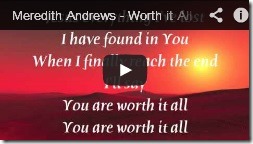
I am hearing...“Jesus everything I've lost I have found in You / When I finally reach the end I'll say / You are worth it all”
I am pondering these words...If you can live through a moment, you can live through a day, and how you live a day is eventually how you live your life. - Philip Yancey from Rumors of Another World
One of my favorite things...weddings that go on, rain or shine! My beautiful niece made a gorgeous bride last Saturday—and a dry one by ceremony time.

A thought to share...Trees by Joyce Kilmer and photo of a tree in the Joyce Kilmer Memorial Forest from our trip last week
I think that I shall never see
A poem lovely as a tree.
A tree whose hungry mouth is prest
Against the sweet earth's flowing breast;
A tree that looks at God all day,
And lifts her leafy arms to pray;
A tree that may in summer wear
A nest of robins in her hair;
Upon whose bosom snow has lain;
Who intimately lives with rain.
Poems are made by fools like me,
But only God can make a tree.

* * *
What’s happening in your day?
The Simple Woman's Daybook
...where every day is a blank page
Past Daybooks

Most of us spend so much time thinking about where we have been or where we are supposed to be going that we have a hard time recognizing where we actually are.
BARBARA BROWN TAYLOR
The trail was listed as 2 miles. But it felt much longer.
In one of the last remaining virgin forests in North Carolina—the Joyce Kilmer Memorial Forest—the view was grand.
But the terrain was touchy. You had to go slow. Not only because of the incline, but because of tree roots and rocks and stumps.
You had to pay attention to where each foot landed.
You had to notice.
You had to stay grounded.
It’s a spiritual discipline to stay grounded. To remember how to walk on the earth as we live in the Kingdom.
To remember that where we are now may be just where we need to be. In this moment is where I AM resides.
Sometimes we do not know what we know until it comes to us through the soles of our feet, the embrace of a tender lover, or the kindness of a stranger.
Touching the truth with our minds alone is not enough.
We are made to touch it with our bodies.
Back home, the walk is easier. I leave my shoes unlaced in the closet. I walk barefoot outside, stepping quickly over the hot pavement to cool my toes in the grass. Ever watchful for thorny weeds or ant resorts, I still enjoy the sensation of nothing under my feet but earth.
It’s when feet are uncovered they’re most aware of the ground.
To go barefoot is to live raw.
To notice each step.
To track the refined nuances of pain and pleasure.
To watch for prints of the One already rounding the earth so you can match his stride and pace your journey to his walking speed, slow enough to pay attention but fast enough to keep moving.
So I walk.
With shoes off. On holy ground. Here and now.
When we stepped off the mountain trail after the supposed two miles had ended, our feet were tired.
But our souls were grounded.
* * *
What holy ground have you stepped on lately?
The spiritual discipline I’m practicing in June is “The practice of walking on the earth: Groundedness.”
Imagine you believe (5/31)
No regrets for this (5/30)
What’s on your nightstand? – May ‘13 (5/28)
“Falling in Love with God” - Book review (5/24)
Up by the roots (5/22)
An easy memory challenge! Classics for the summer (5/20)
Almost-Grown: How to Keep the faith (5/16)
The safe life? (5/15)
Whose world is real: Theirs or ours? (5/13)
His last words are ours. Thank you, Dallas Willard (5/9)
Write back (5/8)
Are you a Pharisee? (5/6)
Links I like (5/4)
A May day - 2013 (5/3)
Dirt under your fingernails? The practice of physical labor (5/1)
What if you believed . . . God really is all powerful?
What if you believed . . . you are more loved than you dream, just as you are, right now?
What if you believed . . . you’ve already been given everything you need?
What if you believed . . . Jesus is inside you, all the time, everywhere?
What if you believed . . . everything really will turn out okay in the end?
What if you believed . . . every promise of God will come true?
What if you believed . . . the Spirit would never not empower you?
What if you believed . . . you’ll always know what you need to know at the right time?
What if you believed . . . you will honor God today by believing?
What if you believed . . . all of it is true—every story, every miracle, every grace—and lived like you believed it?
Imagine that.
* * *
It’s raw thought—5 minutes of writing with no editing—on Imagine. So this must be what’s on the tip of my brain, for better or worse.
What would you add? What if you believed . . . ?
Can you imagine it?
It's Wednesday morning. The silent prayers around the table have ended. Now the group of ladies meeting each week are asked to recite the Lord's Prayer together.
There'd be no shame in not knowing it.
But I'm glad I do.
Another day, another group. This time around a gravesite. The pastor requests those gathered around to say Psalm 23, “The Lord is my shepherd . . . .”
We do.
I'm comforted in the recitation.
There are certain things I have regretted learning through the years. Like lyrics memorized from some of Prince's songs. Or Alfred Hitchcock's The Birds watched one too many times. Or hours wasted reading books with no
intrinsic value whatsoever.
But there's one thing I've never regretted learning:
Bible verses.
It sounds corny, I realize. But time spent repeating Truth over and over hasn't disappointed me yet.
I'm slow at it, granted. And I might forget tomorrow what I learned today. But even so, some things do stick. And even when they don't, the value in the moment is rich.
The Spirit touches deeper than actual words.
Because I'm not just spending time with alphabet letters—I’m spending time with the Lord. I seek—and find—him in the words and under the words and through the words.
I don't have to memorize scripture to spend time with him.
But I’ve never had regrets when I do.
* * *
Just started
 The Fault in Our Stars
by John Green
This novel is a witty but serious story of teenage cancer patients.
Jenna said it made her sob uncontrollably when she finished it. So why am I reading it? Because she thought the cry was worth it. That’s good enough for me, too.
 Dancing Priest
by Glynn Young
This one is by a fellow-blogger that I’ve read and admired for a few years now. It’s a college coming-of-age story about an American brother and sister studying abroad and the life and love they find there.
(Two novels on my nightstand? Who am I?)
 The Icarus Deception
How High Will You Fly?
by Seth Godin
The mythological Icarus was warned not to fly too high. But he was also warned not to fly too low.
Seth Godin writes here about the danger of living too centered inside our comfort zone. Be brave; make art; care more.
 The Gospel According to Peanuts
by Robert L. Short
My niece Danielle has loaned me her well-worn copy of this 1965 book about the spiritual parables found in Peanuts. As I read, I’m getting another glimpse into her heart about why she’s been telling me for years I should read this book.
Therefore if there is some truth in art (and it must follow, as the night the day, that the greater the art the more truth-full it will be) that the Christian observer can point to, he can then by this means speak a word to his brother who might not be willing to listen in any other way.
 Rumors of Another World
What on Earth Are We Missing?
by Philip Yancey
Are we too caught up in this physical world that we miss the underlying spiritual world? I haven’t met a Yancey book yet that doesn’t move me to think deeper about life and God.
If you can live through a moment, you can live through a day, and how you live a day is eventually how you live your life. I spend so much energy on the correct way to live in general that I miss the specific moments that are actually the only way I can live.
 Writing to Change the World
by Mary Pipher
I’m not so vain to believe my writings change the world. But I can write about what changes my world. And what in my world changes. This book is part practical and part inspirational about the writing process by an author who is both writer and therapist.
Still reading
 Understanding Jesus
A Guide to His Life and Times
by Stephen M. Miller
An excerpt: “A Bible latecomer, Satan makes his grand entrance into scripture only when he arrives to tempt Jesus. That’s the first time Satan shows up as a spiritual being. Before that, Satan wasn’t used as a person’s name. It was just a Hebrew word that meant “accuser.” Old Testament writers used that word to describe all kinds of people—including revered characters such as David, Solomon, and even God when he angrily accused Israel of sin.”
Finished from April’s nightstand
 Accidental Pharisees
Avoiding Pride, Exclusivity, and the Other Dangers of Overzealous Faith
by Larry Osborne
You’re not a Pharisee, right? Me neither. So we all think. This book helps us take a closer look at ourselves to find the truth.
My review here of Accidental Pharisees.
 Transformational Architecture
Reshaping Our Lives as Narrative
by Ron Martoia
A favorite of the month. Excerpt: As long as Christianity is primarily understood as a batch of propositions in which God is judging how well we execute them, we will have problems getting people interested in the story, primarily because it is an uninteresting and inaccurate downer.
 From Eternity to Here
Rediscovering the Ageless Purpose of God
by Frank Viola
When the Father gives us something, it’s always His Son. When the Son gives us something, it’s always Himself. This insight greatly simplifies the Christian life. Instead of seeking many spiritual things, we seek only Him.
 The Pressure’s Off
by Larry Crabb
So very good! When the law works, we become proud, though we disguise it as gratitude. . . . When the law doesn’t work, we assume we simply didn’t follow it well enough. We believe someone failed, usually us. We become more defeated than trusting. It doesn’t occur to us that the law might no longer be in effect.
. . . Old Way prayers come in at least three varieties: Change that. Use this. Satisfy me. . . . the New Way is rather Lord, I come (just as I am. One thing I ask—let me see Your beauty. And seeing Your beauty, let me love like You and live like You.)
 The Gifts of Imperfection
by Brené Brown
Sigh. I know I don’t have to be perfect, but oh, how I do want to be. Instead, I can lean on Christ’s perfection. And live authentically, make connections, and be compassionate.
Once we let go of scarcity, we discover the surprising truth of sufficiency. …Sufficiency isn’t an amount at all. It is an experience, a context we generate, a declaration, a knowing that there is enough, and that we are enough.
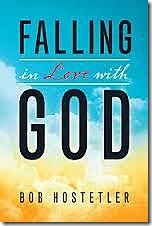
 Falling in Love with God
by Bob Hostetler
Using the book of Hosea as a base, this book shows you the overwhelming love of God as a prompt for your love of him. My review here.
Can you possibly put yourself in that story and not fall in love with a God who would look beyond your faults, your rejection, your betrayal, your indifference, your running from his love, and still love you with such an unreasonable, immeasurable, unstoppable love?
 Open Heart
by Elie Wiesel
A short but vulnerable look inside his heart when at age 82, Elie Wiesel underwent emergency heart surgery.
His honesty: In truth, for the Jew that I am, Auschwitz is not only a human tragedy but also—and most of all—a theological scandal. For me, it is impossible to accept Auschwitz with God as without God. But then how is one to understand His silence?
* * *
What book(s) are you reading this month?

And understanding how God has so faithfully stood by us—even when we don’t thank him, think of him, or even remember him—is a key part of the process of falling in love with God.
BOB HOSTETLER
 Lots of Christians may claim to *know* God. But how many genuinely *love* him?
This book—Falling in Love with God—is meant to help with the transition from head knowledge to heart love. Using the Old Testament book of Hosea (and modern love song lyrics—nice touch), author Bob Hostetler writes of learning how to grow a deeper relationship with God.
Does he succeed? It depends on where you are already and where you want to go. But either way, we all have room to grow, and this book can help guide you further along the continuum.
While I wasn’t as impressed with this book as I was another Hostetler book, Quit Going to Church (loved that), if you’re wanting to study Hosea, this is the one for you. (And if you want a modern Hosea novel, read Redeeming Love by Francine Rivers).
So how do you fall in love with God? You begin unwrapping how much he loves you. It’s a lifelong project. And as you go, you’ll find yourself loving him more and more. (A great book on that is The Good and Beautiful God: Falling in Love with the God Jesus Knows by James Bryan Smith.)
Quotes from How to Fall in Love with God:
Because, you see, one key to falling in love with God is experiencing the scandal of God’s love for you.
God didn’t ask Hosea to proclaim his love, to prophecy his love, to preach about his love, until Hosea had tasted on a human scale the extent of God’s condescension.
We talk about choosing Christ. We sing, “I have decided to follow Jesus,” and that’s certainly how it looks from our perspective. But from the Bible’s perspective—and from Hosea’s perspective—it looks more like this:
“You were dead in your transgressions and sins . . . gratifying the cravings of [your] sinful nature and following its desires and thoughts. . . .
But because of his great love for [you], God, who is rich in mercy, made [you] alive with Christ even when [you] were dead in transgressions—it is by grace you have been saved.
Ephesians 2:1,3,4-5 NIV
I have discovered that the only thing that will heal my waywardness, my unruly heart, my tendency to wander from God and get into all sorts of trouble, disappointment, and dysfunction is letting God love me.
It’s his love that heals me.
That’s why I pray. That’s why I read the Bible every day. Because I have just one job every day, and that is to put myself in God’s hands and let his love heal me and make me more and more like the tree he talks about in Hosea 14. That’s my experience.
* * *
View the trailer for Bob and Falling in Love with God.
My thanks to ACU Press/Leafwood Publishers
for the review copy of this book
Then he said to the tree, “May no one ever eat fruit from you again.”
Mark 11:14

I hate getting rid of plants. I love green things.
But sometimes some of them have to go. Even big ones.
When we bought our loropetalum shrubs twelve years ago, they were so tiny. We planted them far apart. We thought they’d stay reasonably manageable.

But they didn’t. Even in our red clay dirt, they grew disproportionately. Every year Jeff would prune them back hard. But every spring they’d grow new limbs with a vengeance.
Until there was only one thing left to do.
Pull some out. By the roots.
So a week ago, because this wouldn’t work for us, Jeff tied one end of his rope around a trunk and the other to his truck, and pulled. I couldn’t watch.
After it was over, I looked into the empty spot. And involuntarily breathed deeper. Surprisingly, seeing the void made me happy, not sad.
Because now there was breathing room. Openness. No more overcrowding.
I’ve seen it happen this past year. When pruning wasn’t enough, I had to let Jesus curse some of my prize fig trees to death.
I wanted to shut my eyes and not watch.
But after it was done, breathing came easier.
Now with room to maneuver, I could stretch in new directions previously unexplored.
I’m still slow to pull up green things; that can be good. But sometimes, when I’m too crowded in and the view has long been blocked by overgrown shoots, I need to hand God the rope and let him pull some things up by the roots.
Because in the open space, faith has room to grow outward, not just inward.
* * *
Do you have trouble saying no? How do you eliminate clutter from your life?
RELATED:

Register NOW at Do Not Depart to memorize (or refresh) familiar but important passages of the Christian faith.
You’ll receive a monthly e-mail with encouragement, links, and tips on memorizing scripture. For weekly accountability, join our Facebook group.
A full-text printout is here in the most familiar version for each scripture, but memorize in whatever version YOU prefer.
MEMORY CLASSICS SCHEDULE [click here for printable schedule]
Week 1, Jun 3-Jun 9, John 3:16
Week 2, Jun 10-Jun 16, Psalm 23:1-3
Week 3, Jun 17-Jun 23, Psalm 23:4-6
Week 4, Jun 24-Jun 30, Jeremiah 29:11
Week 5, Jul 1-Jul 7, Matthew 6:9-11
Week 6, Jul 8-Jul 14, Matthew 6:12-13
Week 7, Jul 15-Jul 21, Romans 8:28
Week 8, Jul 22-Jul 28, Ephesian 2:8-9
Week 9, Jul 29-Aug 4, 1 Corinthians 13:4-5
Week 10, Aug 5-Aug 11, 1 Corinthians 13:6-7
Week 11 1, Aug 12-Aug 18, Proverbs 3:5-6
Week 12, Aug 19-Aug 25, Philippians 4:13
* * *
I’m in! Are you?
 Maybe your child is about to graduate. Or already away at college or on their own.
Or maybe you just want to get ready now for what’s to come later.
“Let the children come” (Matthew 19:14) isn’t just for your little ones.
Help your children of all ages continue coming to the Lord.
How can you assist their transition from pizza party youth groups to an authentic working faith of their own?
Not by old strategies. What worked at nine won’t work when they’re nineteen. You no longer choose their bedtime Bible stories. You can’t drag them to Sunday school each week. No more gold stars for Bible chapters read.
So what can you do to help your older children stay in the Word?
HERE ARE 8 GUIDELINES:
* * *

What advice would you give parents of college-age children?
What’s a struggle you’re having or anticipating for that age?
What helped (or hindered!) your faith after you turned 18?
I’m writing at Do Not Depart today. Please join me there.

I did it again last week.
And again, it hurt. Bumping my thigh on the corner of our bed frame left me this week with a beautifully-colored bruise as proof, a mark quite noticeable.
This world is not a safe place.
God is “not a tame lion.”
(Aren’t we forever grateful to Lewis for that image?)
God is not in me to shower me with the blessings of short lines at Walmart, pretty shoes that don’t hurt my feet, ne’er an experience with chill bumps or sweat drops.
I don’t live in a bubble, gifted with perfect protection here just because I believe in Jesus.
But what I get is better, even though I’m still having to grow into that realization.
What I get is better because what I get is what I need.
Larry Crabb sums it up well in The Pressure’s Off:
What then is our greatest need? We need . . .
radical forgiveness that makes it possible for unholy people to come near to a holy God and live;
supernatural love that empowers naturally selfish people to care more about someone else other than themselves, thus revealing God;
spiritual might that actually changes bad people into good people, not good merely by society’s standards—we have plenty of folks like that—but good like God, good enough to value ultimate goodness.
In my world, I’m vulnerable.
To lust of the flesh, of the eyes, to pride of life.
But in his world, I’m safer than I think.
From condemnation, from loneliness, from meaninglessness.
Nonetheless, I’ll still bruise up, get headaches (and heartaches), and waste time in long lines.
It’ll leave marks on me.
But to encounter God in the midst of it all?
That’s the good life.
The saved life.
The only life worth living.
* * *
What dangers have you encountered lately?
What’s a sign you’re living the good life anyway?
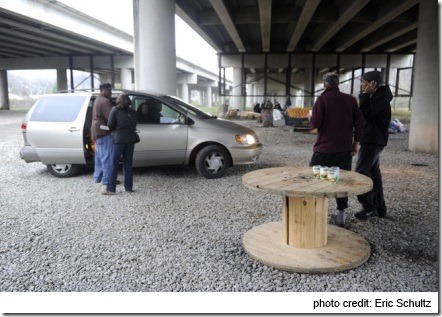
Buckaroo (not his real name) and I are engaged in a conversation about the government. It’s getting heated, not because we’re in opposition but because the subject gets him riled up.
I’m getting uncomfortable, thinking I best change the subject to something less volatile.
But then he says something that shakes me.
If the world as we know it ever comes to a halt, whether it be by our own government (Buckaroo’s presumption) or by outside forces, he says he knows who the survivors will be: his kind.
His people—the homeless—know how to survive.
I believe him. They prove it every day.
They are survivors. How else could they live day after day with the substandard food they eat, the poor sanitation they have, the diabetes and cancer and alcoholism and drug addictions and mental illnesses that many endure?
Some do die, of course. Many do die. And eventually all die, as we do.
But many live. And live long. They’re survivors.
Sometimes I’m not sure whose world is the real one: theirs or ours.
My world feels comfortably real on my smooth drive on the Parkway overpass, singing worship tunes from my USB stick, bottled water in my cup holder, a packed purse by my side.
But underneath that same overpass is their world, a different world. It houses tents, a fire for cooking and warming, and people with few possessions.
Their world feels brutally real as I stand among them Saturday morning and chat with Buckaroo.
After we drive back to our church building, back into the world as I know it, I close ranks with those like me and we hold hands and Norm words a prayer from all of us, for all of them—the survivors. Thanking God for the lessons those survivors teach us. If they can keep going on, so can we.
I want Buckaroo and his friends—now my friends, too—on my side not if, but when, the worlds we both know ever come to an end.
Because they will come to an end.
So for now, I’ll take another step into Buckaroo’s world and pray it makes mine a little less plastic and a lot more authentic. That it makes his a little less lonely and a lot more loved.
That it blends both our worlds, making them less about us and more about God. After all, only God’s world is truly real, the only one that will last forever.
I want us both to be survivors in that one.
* * *
RELATED:

You couldn’t read him lightly or quickly. His words took time to sink in. But, oh, they were worth it.
Even if you haven’t read Dallas Willard’s books yourself, you’ve likely been influenced by them through someone else who has.
His books have been some of my favorites: The Divine Conspiracy, Renovation of the Heart, The Spirit of the Disciplines, The Great Omission. I frequently discover some of my newer favorite authors were either mentored by Willard personally or indirectly through his writings.
Willard sent a clear and consistent message in all his writings:
Dallas Willard died Wednesday after a short battle with cancer. His last words are reported to have been, “Thank you.”
How appropriate for us to echo those words back to him.
Thank you, Dallas Willard, for teaching us how to better love God and love others. May your words live on for God’s glory for many years to come.
QUOTES
A few favorite words I’ve recorded from Dallas Willard:
Renovation of the Heart: Putting on the Character of Christ
~ The greatest need you and I have—the greatest need of collective humanity—is renovation of our heart.
~ But this eternal kind of life is not a passive life. Passivity was for the Israelites, and it is for us one of the greatest dangers and difficulties of our spiritual existence.
~ “Knowledge” in biblical language never refers to what we today call “head knowledge,” but always to experiential involvement with what is known—to actual engagement with it.
~ The way to get as many people into heaven as you can is to get heaven into as many people as you can.
The Spirit of the Disciplines: Understanding How God Changes Lives
~ Human life cannot flourish as God intended it to . . . if we see ourselves as “on our own”—and especially if we struggle to preserve ourselves that way.
~ The disciplines are activities of mind and body purposefully undertaken, to bring our personality and total being into effective cooperation with the divine order.
The Great Omission: Reclaiming Jesus’s Essential Teachings on Discipleship
~ Much of our problem is not, as is often said, that we have failed to get what is in our head down in our heart. Much of what hinders us is that we have had a lot of mistaken theology in our head and it has gotten down into our heart. And it is controlling our inner dynamics so that the head and heart cannot, even with the aid of the Word and the Spirit, pull one another straight.
~ Grace is not opposed to effort, it is opposed to earning. Earning is an attitude. Effort is an action.
~ We have emphasized trying but not training . . . . We have lost discipleship largely because we have lost Christ as Teacher.
~ Any time ritual and compassion (for example, for hunger) come into conflict, God, who gave the law, favors compassion. That is the kind of God He is.
The Divine Conspiracy (see here)
* * *
Do you have a favorite book by Dallas Willard?
Sharing at Spiritual Sundays
Before they call I will answer; while they are yet speaking I will hear.
Isaiah 65:24
THE EMAIL
It felt risky. I wasn’t sure I should say it. I wondered if it would change things, make things weird.
I wordsmithed it cautiously, copied it to Gmail, and hit send.
Then waited.
For something.
For anything.
Anytime now.
Please?
You, too? Waiting to hear back from someone about something?
NO RESPONSE
Let’s get this out of the way: I’m not always good about responding either.
But that doesn’t mean I couldn’t be better. Or that you couldn’t be either.
We all should write back.
(Or text or message or call or visit . . . .)
Because we all know what it feels like when someone doesn’t get back to us.
It hurts.
At the very least, you feel unheard. Did they even get my message? Maybe my email bounced? Was my voicemail deleted?
NOW WHAT
So what can we do when someone doesn’t respond to us? Not much. We can’t make someone pay attention. Try again if it’s important. Or forgive and move on.
But we can control how we respond to others.
Be the one to reach back.
You might not heal the hurt or dispense wisdom or fix any problems with your reply. But when you affirm that you hear, you stay connected.
Because any acknowledgement, however short, is a better message than the one sent with no response.
So say something.
Hey, I hear you. I care. You matter.
Write back.
* * *
Who do you need to respond to today?
It’s not too late. It can be short, but let it be something.