image map Home Favorites Reading About Contact
Showing posts with label Cross He Bore by Leahy. Show all posts

Outer Darkness - 13

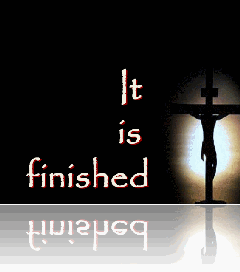
Selections from The Cross He Bore, Chapter 13it is finished

Matthew 27:45
"Now from the sixth hour there was darkness over all the land until the ninth hour."

* * *

Then, suddenly, it grew dark! The silence was eerie; just the occasional splatter of blood on the stones, or the crunch of a soldier's step. the terrible picture of suffering and humiliation faded from view. And what a scene that was!

* * *

This was the Passover season. Just before the first Passover a plague of darkness betokened the curse of God upon his enemies (Exodus 10:21-23). The darkness that enveloped the Saviour at Calvary was clearly a visible expression of the inner darkness that wrung that dread cry of dereliction from his lips: ‘My God, my God, why have you forsaken me?’ (Matthew 27:46).

To be forsaken by God is hell.

* * *

Christ spoke solemnly of ‘outer darkness,’ associating it with unspeakable anguish (Matthew 8:12; 22:13; 25:30). To redeem his people he entered and endured that darkness.

Now he calls us ‘out of darkness into his marvelous light.’ He is the true light and those who follow him ‘will not walk in darkness, but will have the light of life’ (1 Peter 2:9; John 8:12).

More thoughts from Chapter 13

The King Among Bandits – 12

Selections from The Cross He Bore, Chapter 12

Luke 23:33
"And when they came to the place that is called The Skull, there they crucified him, and the criminals, one on his right and one on his left."

* * *

He was fully and freely identified with sinners, for such he came to save.

In no way did the Lord resent being placed among such men at Calvary. The quotation from Isaiah 53:12 may literally be translated, ‘He let himself be numbered with the transgressors.’

He was totally content with his position; he would not have had it otherwise. He knew that his place among these bandits was willed by his Father and his Father’s will was his will. These criminals, placed there by God, were appropriate company at this time for his Son.

* * *

Numbered with the transgressors! There is comfort and hope for the greatest sinner who repents. Let God’s people bow humbly before the cross and marvel at the fact that any should find mercy.

Let each one say, ‘Why me?’ Is there any reason apart from the grace of God?

* * *

Not the proud and arrogant thought, but, as Amy Carmichael puts it, ‘most reverent thought’ befits the sinner before the cross. As we stand in thought before that cross our emotions are mixed. How dreadful and yet how wondrous is this place!

More thoughts from Chapter 12

Satan’s Cup Refused - 11

jesus on cross Selections from The Cross He Bore, Chapter 11

Mark 15:23
"And they offered him wine mixed with myrrh, but he did not take it."

* * *

It was customary, by way of preparation for crucifixion, to offer the condemned a sedative drink. The soporific mixture offered to the Saviour was immediately refused. As soon as he tasted it he realized what it was (Matthew 27:34).

A drink to quench his thirst would have been welcome, and he did accept such a drink (Matthew 27:48). That sour wine he accepted, but the drugged drink he instantly refused. To the very last he must have full possession of his senses.

* * *

What if Christ had accepted that cup (and that is to imagine the impossible)? Then, with a befuddled brain, he could not have prayed for the soldiers who were waiting to nail him to the cross. Then those seven great saysings ont he cross would never have been uttered. Then his obedience would at least have been broken and all would have been lost.

* * *

Adam had disobeyed knowingly, with all his senses clear. The ‘last Adam’ must obey willingly and with a clear mind.

More thoughts from Chapter 11

Outside the Gates – 10

Selections from The Cross He Bore, Chapter 10

John 19:17
“And he went out, bearing his own cross, to the place called the place of a skull, which in Aramaic is called Golgotha.”

* * *

To say that Christ suffered outside the camp in order to sanctify the people through his own blood was a stunning statement for Jewish readers (Leviticus 16:27; Hebrews 13:12,13). It was shocking to be told that Christ made his great sacrifice on what they considered unholy ground, outside the camp.

In ancient Israel when a man left the camp he needed ceremonial cleansing before he could return (Leviticus 16:26). How, then, could Christ sanctify his people on unsanctified and profane ground?


* * *
...As in Moses’ day, sin had rendered the camp unholy, so the situation was reversed: inside the camp was unholy, but God’s presence in the temporary sanctuary outside the camp made that place holy. It was sacred because of God’s presence.

...It was fitting and right that the Saviour should offer himself a sacrifice for our sins outside the gates. Now, there is no further need for ‘holy places’ for the worship of God, nor in God’s sight can there be such.


* * *

Christ had to die at Jerusalem, the city of the Word. No other city would have done. It was the only place in the economy of redemption where the Lamb of God could die outside the gates as one accursed of God.

As the priests hustled Christ outside the gates, they ministered, in spite of themselves, to the preparation of the one and final sacrifice for sin. Jerusalem was the only place; the Passover was the only time. ‘For Christ, our Passover lamb, has been sacrificed. Therefore let us keep the Festival’ (1 Corinthians 5:7,8). ‘What remains now,’ says Calvin, ‘is that we eat, not once a year, but continually.’

Outside the gates! An outcast in God’s universe! No resting place, no sanctuary! But not for long. Soon the gates of heaven will swing wide for the warrior Christ.
Lift up your heads, O gates!
And be lifted up, O ancient doors,
That the King of glory may come in.
Psalm 24:7
~ Frederick S. Leahy

More thoughts from Chapter 10

The Crown of Thorns – 9

Selections from The Cross He Bore, Chapter 9

John 19:5
“Then came Jesus forth, wearing the crown of thorns...” (KJV)

* * *
There he stood, his face bruised, swollen and bleeding, and that thorny crown upon his head. He was so alone, ‘friendless, forsaken, betrayed by all.’

That crown symbolized what sinful man thinks of Christ. He was not to be taken seriously. He was only fit for a stage-play!


* * *
What cries greeted the Saviour in those few eventful days! Hosanna! Hosanna!...Crucify! Crucify! They could not bear the light of the world; they felt more at ease in the darkness of deception and hypocrisy....

The Holy One of Israel exposed them, unmasked them, condemned then and they turned against him with vicious hatred and a consuming desire to destroy him. They would give no glory to this Jesus, no honour, nothing but shame and contempt. The crown of thorns pleased them well. That is the response of the heart of fallen man to the Lord’s Christ.

* * *
If we are to receive the crown of life, Christ must receive the crown of thorns. He cannot be our Saviour any other way....

It is in his diadem of thorns that he stoops low in humiliation and shame and sorrow to seek and to save sinners. It is only by the sharp thorn of his suffering that the poisonous thorn of our sin is drawn. In other words, apart from the cross God cannot forgive sin.

~ Frederick S. Leahy

More thoughts from Chapter 9

The Butt of Mockery – 8

Selections from The Cross He Bore, Chapter 8

Matthew 26:67-68
“Then they spit in his face and struck him. And some slapped him, saying, ‘Prophesy to us, you Christ! Who is it that struck you?’ “

* * *
‘Jesus,’ says Dr. Geerhardus Vos, ‘accepted the cross out of a motive of love for God even more than, and before, He accepted it because of His love for man.’ (Hebrews 10:7)

‘In dying, as in all else He did, He hallowed God’s name.’ This is a truth too often overlooked, and it in no way detracts from the wonder that Christ loves each one of his people with all of his love.


* * *
As that suffering, humiliated figure stood there, his tormentors despised him in their hearts. They thought that he was utterly helpless in their hands. How wrong they were! Christ was never in retreat, never merely passive.

At this moment he was actively and voluntarily exposing himself to the fury of his enemies (Isaiah 50:6). This was costly obedience on the Savior’s part as he deliberately gave his back to those who struck him, enduring patiently and meekly this gratuitous torture.


* * *
Many hands were raised against him, both human and demonic, but Christ knew that there was one hand above all others that smote him. And as he bore our sins that hand did not spare him. ‘It was the will of the LORD to bruise him; he has put him to grief’ (Isaiah 53:10).

~ Frederick S. Leahy
More thoughts from Chapter 8

Sentenced to Death – 7

Selections from The Cross He Bore, Chapter 7

Matthew 26:65-66
“Then the high priest tore his robes and said, "He has uttered blasphemy. What further witnesses do we need? You have now heard his blasphemy. What is your judgment?"

They answered, "He deserves death."

* * *
The Jewish leaders feared and hated this teacher who had exposed their hypocrisy, refuted their arguments and rejected their traditions. They regarded him as a threat to their authority and power. It was their intention from the outset to get rid of him by whatever means. Caiaphas’ chief sin lay in his wanting to do what he did.

* * *
It is important to remember it was not just the Jews who were responsible for Christ’s death. Ultimately all mankind and every person must bear full responsibility. ...Every sinner has said in effect, ‘Away with Him. I will not have this man to reign over me.’ It was the realization of this fact that moved Horatius Bonar to write:
I see the scourges tear His back,
I see the piercing crown,
And of that crowd who smite and mock,
I feel that I am one.

‘Twas I that shed the sacred blood,
I nailed Him to the tree,
I crucified the Christ of God,
I joined the mockery.

Yet not the less that blood avails,
To cleanse away my sin;
And not the less that cross prevails
To give me peace within.
* * *
So the believer can say, ‘Christ embraced me with all my sin and guilt that I might embrace him in all his righteousness.’ That is what Luther had in mind when he said, ‘He died for me; he made his righteousness mine and made my sin his own; and if he made my sin his own, then I do not have it, and I am free.’

~ Frederick S. Leahy
More thoughts from Chapter 7

Taking the Oath – 6

Selections from The Cross He Bore, Chapter 6

Matthew 26:63-64
“But Jesus remained silent. And the high priest said to him, ‘I adjure you by the living God, tell us if you are the Christ, the Son of God.’

Jesus said to him, ‘You have said so. But I tell you, from now on you will see the Son of Man seated at the right hand of Power and coming on the clouds of heaven.’ ”

* * *

Warfield reminds us that our Lord’s life of humiliation ‘was not His misfortune, but His achievement,’ and that ‘He was never the victim but always the Master of circumstance.’ This must be borne in mind as we reflect on the Saviour obediently taking the oath. His response was clear: ‘You have said so,’ meaning, ‘Yes indeed; I am the Christ.’

* * *

All agreed that the prisoner was guilty of blasphemy and that he should die. They refused to acknowledge his claims...The cry of their hearts was, ‘We do not want this man to reign over us’ (Luke 19:14). So answers the heart of fallen man when confronted with Christ and the challenge of his cross and his crown.

* * *

Christ’s solemn oath before Caiaphas echoes throughout the centuries.
‘Are you the Christ?’
‘Yes.’
There is the mighty rock that bears the faith of the people of God in all ages. Those who build on that foundation shall never be confounded; for the mouth of the Lord has spoken it!

~ Frederick S. Leahy

More reflections from Chapter 6

The Dumb Lamb – 5

Selections from The Cross He Bore, Chapter 5

Matthew 26:62-63
“And the high priest stood up and said, ‘Have you no answer to make? What is it that these men testify against you?’
But Jesus remained silent....”

* * *

All too often Christ’s silence has been given a dangerous one-sidedness, as his passive obedience is stressed almost, if not altogether, to the exclusion of his active obedience. Christ’s silence was deliberate, emphatic and authoritative: it was his deed. The passivity of his suffering was real, but so was the activity of his obedience. Led as a lamb to the slaughter and like a sheep dumb before the shearers, he was active right up to and on the cross. He went as a king to die.

* * *

Christ was quick to speak when his Messiahship was challenged (Matthew 26:64). But he never spoke in obedience to man, always in obedience to his Father and in keeping with his mission.

* * *

By a single word Christ might have freed himself from his enemies. But our silent Priest continued majestically to his death. O blessed silence that lay at the heart of our redemption!

* * *

Just as the first temple was erected without sound of hammer, or any iron tool (1 Kings 6:7), so this temple of Christ’s body will be restored in a silence that nothing can profane.

~ Frederick S. Leahy

More reflections from Chapter 5

Satan's Hour - 4

Selections from The Cross He Bore, Chapter 4

Luke 22:53

“When I was with you day after day in the temple, you did not lay hands on me. But this is your hour, and the power of darkness."

* * *

All of history had moved unerringly and inexorably to this hour. Schilder states this so well: God had arranged all of the preceding centuries, all of the intervolutions of time, all of the events from Genesis 1:1 up to this moment—has arranged and moulded them, has had them converge in such a way that there would be a place for this hour, the hour in which His Son will be bound...

He allowed neither the forces above nor the forces below to tamper with the clock of history. He directed the battles of Caesars, the conflicts of kings, the migration of peoples,...and the complex movements of all things in the world in such a way that this hour would come and had to come.


* * *

God’s permission was absolute as Satan mustered his legions for the decisive encounter. The first Adam had been easy prey. How would he fare with this Adam?

* * *

The garden was empty again, this lonely garden that time-wise is situated mid-way between Eden and a greater garden than Eden that is so beautifully described in Revelation 22. The struggle in Gethsemane had been fierce. Soon the struggle would be fiercer still. ‘That old serpent, called the devil and Satan’ had uncoiled and had bared his fangs, poised to strike again and again with all the venom of which he was capable. Trampling on serpents is a most painful experience, especially for the heel.

~ Frederick S. Leahy
More reflections from Chapter 4

Strengthened to Suffer - 3

Selections from The Cross He Bore, Chapter 3

Luke 22:43
“And there appeared to him an angel from heaven, strengthening him.”

Gethsemane is not a place for hurried theological tourism: it is where the believer must linger, watch and pray.

* * *

But it was not the Father’s will that the Savior should die in the garden, and just as after the temptation in the wilderness angels ministered to him (Matthew 4:11; Mark 1:13), so now he was strengthened by an angel. How strange is the sight! A creature sent to minister to the Creator!...There is a place for mystery. There is need for ground on which, in a unique sense, one walks by faith and not by sight.

* * *

For one fleeting moment immense joy must have leaped within Christ’s soul as the Father’s hand touched him. This was a message from home. Heaven was behind him. He was forsaken, but not disowned. His Father was there, somewhere in the darkness. His loud cries and tears had not been unnoticed.

* * *

It is true that Christ preached the gospel, but as R. W. Dale says so well, ‘The real truth is that while He came to preach the Gospel, His chief object in coming was that there might be a Gospel to preach.’

~ Frederick S. Leahy

More reflections from Chapter 3

Prayerful Submission - 2

Selections from The Cross He Bore, Chapter 2

Matthew 26:39
And going a little farther he fell on his face and prayed, saying, "My Father, if it be possible, let this cup pass from me; nevertheless, not as I will, but as you will."

* * *

Was the Father indifferent to the Son’s passionate pleadings in Gethsemane? Did he ever for a moment cease to be well pleased with him? Far from it. The writer to the Hebrews assures us that the Saviour ‘was heard because of his reverence’ (Hebrews 5:7). The proof of his being heard is his resurrection from the dead. In that sense he was ‘saved from death’.

* * *

In Gethsemane it was never a question whether the Saviour would obey or disobey. In Eden God asked, ‘Adam, where are you?’ In a sense the question was repeated in Gethsemane and this Adam did not try to hide; he had no need to; his whole response was clearly, ‘Here am I!’ Willingly and voluntarily the good shepherd laid down his life for the sheep.

* * *

As we meditate on Christ’s prayerful submission in Gethsemane, we should realise that there, as Philip E. Hughes puts it, ‘we see him enduring our hell so that we might be set free to enter his heaven’. And so at unspeakable cost he drank ‘the cup’ to the very last drop. ‘Shall I not drink the cup that the Father has given me?’ (John 18:11). What obedience! What love! What mystery!

~ Frederick S. Leahy

* * *
Psalm 116:12-13
What shall I render to the LORD for all his benefits to me?
I will lift up the cup of salvation and call on the name of the LORD.

More reflections from Chapter 2

Man of Sorrows - 1

Selections from The Cross He Bore, Chapter 1

Mat 26:36-37
Then Jesus went with them to a place called Gethsemane, and he said to his disciples, "Sit here, while I go over there and pray."


And taking with him Peter and the two sons of Zebedee, he began to be sorrowful and troubled.


The statement in Matthew 26:36, 37 is significant. Christ has known sorrow before this, but the assertion that in Gethsemane he began to be sorrowful and troubled indicates a sudden steep descent into the billows of distress. Now, as never before, all God’s waves and billows began to sweep over him (Psalm 42:7).
* * *

He had repeatedly spoken of his death to his disciples, telling them what that death would accomplish. He had prayed with the utmost confidence in his high priestly prayer (John 17). Why, then, is there this sudden plunge into such awful agony, why this shuddering horror? Why does the divine record say that in Gethsemane our Lord BEGAN to be sorrowful, sorrowful in a new and terrible way? Was it not because God began forsaking him then? How else is this sorrow unto death to be understood?

* * *

What cup (John 18:11)? ‘THIS CUP’—not some future cup. The cup that was symbolized in the feast (Matthew 26:27,28) was now actual: God was placing it in the Saviour’s hands and it carried the stench of hell.

~ Frederick S. Leahy

More reflections from Chapter 1

Let's read together—“The Cross He Bore”

Sign up here
Chapter-by-chapter here

The Book:
I don’t typically recommend a book I haven’t read myself. But I’m trusting Tim Challies’ word that The Cross He Bore: Meditations on the Sufferings of the Redeemer by Frederick S. Leahy is a worthy one.

The Goal:
Read one (very short) chapter a day, beginning Sunday, March 29, and ending on Good Friday, April 10.

The Chapters:
1. Man of Sorrows
2. Prayerful Submission
3. Strengthened to Suffer
4. Satan’s Hour
5. The Dumb Lamb
6. Taking the Oath
7. Sentenced to Death
8. The Butt of Mockery
9. The Crown of Thorns
10. Outside the Gates
11. Satan’s Cup Refused
12. The King Among Bandits
13. Outer Darkness

The Foreword:
Edward Donnelly says this,
We are too apt to hurry past the cross, to undervalue, in spite of ourselves, the supreme mystery of the ages by a shallow assumption that we know it all. [Um, that hurts—I think he’s talking about me.] We don’t and never will. But we need to take time to learn as much as we can. We need to ‘behold’, to ‘survey’, to ‘stand and stare’.
The Reading Group:
If you want to “stand and stare” together, Tim is hosting a group of readers on his blog, posting daily on each chapter. I hope to post my thoughts here daily as well. You have time to get a copy and read along ($3.75 at Monergism Books, or $5.75 at Amazon). If so, I hope you, too, will share your thoughts here or somewhere. At least share in communion with the Father, most importantly.

The Introduction:
I’m trying not to read ahead. I want to keep it fresh for the appropriate time. I’ve only allowed myself to read the Foreword and the Introduction. So far, so good. The last statement of this paragraph in the introduction surely convicts me. You?
It is not my intention in these brief chapters to give a detailed account of the trial and crucifixion of our Lord. That is done in the Gospels infinitely better than by any mere man or woman. Rather, I have selected certain passages which help us to meditate on what the Saviour endured for our salvation. If our meditation on the cross be meagre, can our love for the Saviour be great?

LinkWithin

Related Posts with Thumbnails